
RICHMOND · GAS BOILER REPAIR
What still works?Find the cause first.
Gas boiler repair in Richmond starts by separating the appliance fault from the heating circuit, hot-water demand and building controls. SkyLimit Heating & Gas helps you describe the problem clearly, assess the affected equipment and decide what work to approve. A cold room, intermittent hot water or a displayed code deserves a diagnosis before a replacement part is selected.
Listen to the Richmond repair guide
A short spoken overview of the fault assessment and booking details.
AI-generated voice summary. Read the full guidance below, including the emergency instructions.
Gas boiler repair in Richmond: define the fault boundary
Tell us what still works as well as what has stopped. That distinction makes your first conversation more useful. These three situations provide a starting point for professional assessment; they are not a diagnosis or a reason to open the boiler cabinet.
Taps work. Rooms stay cold.
In a combi system, domestic hot water can work while the heating demand is not being satisfied. The technician needs to establish whether the thermostat signal reaches the controls and whether heated water moves through the intended circuit.
Report whether all rooms are affected, whether a thermostat indicates a call for heat, and whether the change was sudden or gradual.
Rooms heat. Taps fluctuate.
First identify whether your boiler produces tap water directly, heats an indirect tank, or is completely separate from the water heater. These arrangements have different components and demand controls.
Describe which fixtures are affected, whether the problem occurs at the same time as heating, and whether an error appears during water use.
Most rooms are comfortable.
A single cold floor or room can point the assessment towards local controls, a zone valve, an emitter or water circulation. A working boiler display does not confirm that every circuit receives useful heat.
Name the affected zone and its thermostat. Tell us about recent flooring, thermostat replacement or renovation that may be relevant.
Stop the routine booking process for a safety emergency. If you smell gas, leave immediately and avoid ignition sources. Call FortisBC at 1-800-663-9911 or 911 from outside; do not operate switches or use a phone indoors. For a carbon monoxide alarm, get everyone outside and call 911. Follow FortisBC gas-leak guidance and its carbon monoxide instructions.
Small observations that improve the assessment
You do not need to identify a failed part yourself. A short record of normal operation and the interruption is more useful than a long list of guesses. Read only information visible without opening equipment or entering an unsafe space.
| Observation | What to record | Why it helps |
|---|---|---|
| Intermittent shutdown | Exact code, time, operating demand and whether it repeats. | A fault during heating may need a different test sequence from a fault during tap-water demand. |
| Visible moisture | Location and a photo taken safely from outside the cabinet. | Condensate, a piping connection and a component leak must be distinguished before the repair scope is agreed. |
| Pressure changes | Visible gauge reading and whether the system was heating or cool. | Changing readings provide context; repeated refilling does not diagnose the cause. |
| New noises or short cycles | When the sound occurs and which rooms are calling for heat. | Controls, flow and operating conditions need consideration alongside the appliance. |
Do not repeatedly reset a locked-out boiler, change gas settings, bypass a safety device or try an acid wash. These actions can obscure the original fault or create additional risks. If the equipment is not operating normally, ask for model-specific guidance while arranging assessment.
Richmond neighbourhoods: the property changes the brief
Steveston, Seafair, Thompson, Broadmoor, Blundell, City Centre, Cambie and Hamilton are useful location references when arranging access. The neighbourhood name alone does not tell us which boiler, piping layout or repair you need. Our booking questions focus on the actual building and equipment.
Detached homes and renovated properties
For a home in Steveston, Seafair, Broadmoor or Blundell, explain whether the heat comes from radiators, baseboards, in-floor circuits or a mixture. An addition can have its own thermostat and water circuit. If the new area is cold while the original rooms heat, that distinction belongs in the repair brief.
In Thompson and around Terra Nova, include the appliance location and practical access details. A utility room, garage or compact mechanical space can change how the equipment and surrounding pipework are inspected. The assessment must follow the actual installation, not an assumed house style.
Townhouses and strata buildings
In City Centre and Brighouse, or a townhouse in East Cambie, West Cambie or Hamilton, clarify whether the boiler serves your residence alone. Shared heating equipment needs the appropriate manager or strata representative involved. Confirm access, authorization and any arrangements for a building shutdown before the visit.
For properties around Bridgeport, Shellmont and Ironwood, tell us whether the request concerns a residence or business premises. Commercial or shared equipment may require a separate scope assessment. We confirm suitability and access rather than treating every address as a standard household appointment.
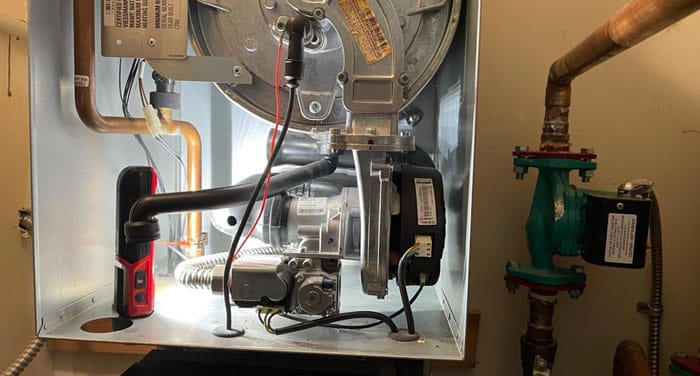
Boiler parts: match the component to the evidence
A repair proposal should connect the reported fault, the test findings and the recommended component. A similar-looking part or matching brand name is not enough. The full model, serial number and relevant revision help establish compatibility. Availability, the supplier’s return conditions and any applicable warranty should be confirmed before approval.
| Part group | Assessment focus | Approval question |
|---|---|---|
| Circulator and zone valve | Demand signal, operation and flow through the affected circuit. | Is the fault in the component, its control or the surrounding circuit? |
| Temperature and flow sensors | Connections, measured response and the model’s diagnostic procedure. | What evidence distinguishes a failed sensor from wiring or operating conditions? |
| Ignition and flame detection | The manufacturer’s sequence and required combustion-related safety checks. | What caused the ignition failure, and what checks follow the repair? |
| Expansion and pressure components | Pressure behaviour, leakage and the installed system arrangement. | Will the work address the reason for pressure changes? |
| Control board and interface | Inputs, supply, connected devices and compatible configuration. | Have external causes been checked before recommending a board? |
| Heat exchanger and seals | Condition, confirmed leakage and the model-specific service requirements. | How does the proposed repair compare with replacing the appliance? |
For more detail on identification and compatibility, read our gas boiler parts guide. Parts are selected after assessment; this page does not promise that every component is stocked or suitable for every model.
Navien, Viessmann, IBC, Bosch, Rinnai and Super Hot
Provide the nameplate information rather than only the logo. A Navien combi, a Viessmann heating boiler, an IBC system, a Bosch appliance, a Rinnai unit and a Super Hot boiler can have different controls and piping requirements across their model families. We do not infer local brand popularity or your equipment configuration from a Richmond address.
Our Navien boiler repair information and Viessmann boiler repair information provide additional starting points. The applicable manufacturer documentation and the installed system still govern assessment. A model and fault code help us confirm the appropriate scope before booking.
Approve a clear scope, then verify the result
- Describe the interruption. Send the address area, model, affected heating or hot-water function, displayed code and safe exterior photos.
- Agree on the assessment. Confirm access, the responsible owner or manager and what equipment the visit will cover.
- Review the finding. Ask what was tested, what caused the problem, which part is proposed and what further work remains uncertain.
- Authorize the repair. Confirm the component, labour scope, availability and applicable terms before work proceeds.
- Check the original complaint. The operational verification should relate to the affected demand and include the safety checks required by the work.
Richmond has its own gas-permit process. Technical Safety BC’s installation-permit guidance directs customers in Richmond to check with the municipality. Installation or alteration work should have the correct authority and requirements confirmed for its scope; a routine component diagnosis should not be presented as a universal permit rule.
If assessment finds that replacement merits consideration, compare the project requirements on our boiler installation in Richmond page. For planned maintenance after the fault is resolved, see gas boiler service in Richmond. Maintenance and a repair visit have different purposes, so ask what each appointment includes.
Questions Richmond homeowners ask
Direct answers for common heating, parts and booking questions. Your specific repair still depends on the model and on-site findings.
Why does my Richmond combi boiler heat the taps but not the house?
A combi boiler uses different operating demands for domestic hot water and space heating. Working taps do not prove that the heating controls, circulation or zone valves are working. Record which thermostats call for heat and whether every zone is cold. A technician can then test the heating demand and water movement rather than assume the boiler needs replacement.
Can one cold room mean the boiler itself is broken?
Yes, but a local distribution or control issue is also possible. If other rooms heat normally, the affected thermostat, zone valve, circulation path or emitter needs assessment. Do not open valves or refill the system to experiment. Describe the room, the heating type and whether the problem began after renovation or service.
Should I order a replacement part using only the fault code?
No. A fault code identifies a condition reported by the control, not necessarily a failed component. The full model, serial number, component revision and diagnostic results are needed before ordering. A sensor fault, for example, may require checking its wiring and measured response before replacing the sensor.
Who should arrange boiler repair in a Richmond strata property?
First establish whether the appliance belongs to the individual home or serves shared building equipment. Ask the strata manager about ownership, authorization, mechanical-room access and shutdown coordination. The repair appointment should have a named decision-maker so diagnosis and approved work can proceed within the agreed scope.
Does a Richmond boiler repair always require a gas permit?
Permit requirements depend on the work being performed. Richmond has a municipal gas-permit process, and Technical Safety BC directs customers in Richmond to check with the municipality. Confirm the correct authority and requirements for the actual installation or alteration before approving regulated work.
Is repeated pressure loss fixed by adding water?
Adding water does not establish why pressure is falling. A leak, expansion problem or other system condition needs assessment. Repeated topping up can hide the cause and introduce fresh water into the heating circuit. Report the gauge readings you can safely see and any visible moisture, without removing covers or changing valves.
What happens after a boiler component is replaced?
The repair needs an operational check relevant to the original fault. Depending on the work, this may include verifying the heating demand, affected zones, domestic hot-water response and required safety checks. Ask for a clear explanation of the failed component, the replacement used and any issue that remains unresolved.
What should I do if I smell gas or a carbon monoxide alarm sounds?
For a suspected gas leak, leave immediately, avoid ignition sources and call FortisBC at 1-800-663-9911 or 911 from outside. Do not operate switches or use a phone indoors. If a carbon monoxide alarm sounds, get everyone outside and call 911. Do not wait for a routine boiler-repair appointment.
Start with what works—and what does not
Send the boiler model, your Richmond neighbourhood and a short description of the affected function. We can discuss the assessment, access and next steps without guessing a replacement part.
Reviewed October 3, 2026. Prepared by SkyLimit Heating & Gas. General equipment information; consult the applicable manufacturer instructions and responsible authority for your installation.
FOLLOW SKYLIMIT IN GOOGLE Add SkyLimit as a Preferred Source so Google can highlight our BC gas-fireplace and HVAC guidance more often for you in Top Stories, AI Overviews and AI Mode. If the button does not load, open Google Preferred Sources settings.Make SkyLimit a Preferred Source