
NEW WESTMINSTER · BOILER INSTALLATION PLANNING
Start with the building.Plan the system.
Gas boiler installation in New Westminster works best when the equipment, water temperatures and building requirements are planned together. SkyLimit Heating and Gas helps you assess the existing heating layout, compare suitable equipment and define the work before the old system comes out.
Listen to the installation plan
A short guide to choosing the system and preparing the property.
AI-generated narration · Summary of this page
Three decisions before choosing a boiler.
Start with what you want to change. A tired appliance, a cold extension and a busy household may point to different work. The assessment should separate a boiler limitation from a distribution or hot-water problem, so the proposed installation answers the actual need.
Define the comfort brief.
- Which rooms are difficult to heat, and when?
- Does the system serve one home, separate suites or a shared building?
- Are radiators, baseboards, floor loops or several emitter types connected?
- Will the project add rooms, alter insulation or change hot-water use?
Tell us about proposed changes before equipment selection. A renovation can alter the heating load, the smallest active zone and the available mechanical space.
Define the constraints.
- Access for removal, installation and future service.
- A workable intake, exhaust and condensate route.
- Gas supply, electrical connections and connected appliance loads.
- Owner, strata and permit responsibilities.
A compact wall-hung unit still needs specified clearances. The usable layout must include valves, piping and access, rather than just the boiler’s outside dimensions.
If you have an isolated breakdown and have not decided on replacement, begin with gas boiler repair in New Westminster. A confirmed fault gives you a stronger basis for comparing repair with a new system.
Gas boiler installation in New Westminster: size for the load.
The old boiler’s input rating is a record of the old equipment, not proof of today’s heating requirement. A heat-loss assessment considers the building envelope and design conditions. The installer also needs to understand how the emitters deliver that heat and how the zones behave when only a small area calls.
An oversized boiler can cycle frequently when the active load is small. Simply choosing a larger model to cover every possible concern can create a different problem. The useful comparison includes the selected unit’s output, minimum firing rate, control strategy and the smallest operating zone.
Ask for two separate answers: what capacity the building needs for space heating, and what arrangement will meet the household’s domestic hot-water demand.
For existing radiators or baseboards, review the water temperature needed on cold days. A condensing boiler’s performance depends partly on system temperatures and return-water conditions. An efficiency label does not promise a fixed saving in every home. Floor-heating circuits may need different temperature control from radiator circuits.
The broader gas boiler installation guide explains the regional planning process. This page adds the access, approvals and property questions relevant to New Westminster.
Choose the hot-water arrangement separately.
| Arrangement | What to establish | Planning consequence |
|---|---|---|
| Heating-only boiler with separate hot-water equipment | Condition and capacity of the existing tank or proposed indirect cylinder. | Allow for storage, piping and coordinated controls where applicable. |
| Combi boiler | Simultaneous fixture use, incoming water conditions and the selected model’s heating and hot-water ratings. | Review delivery at the required temperature rise; wall space alone does not establish suitability. |
| Multiple temperature zones | Radiators, floor loops, thermostats and the smallest calling zone. | Define pumps, mixing and hydraulic separation where the design requires them. |
A combi may suit some households, while storage may better answer other demand patterns. Discuss morning shower use, kitchen demand and any separate suite. Do not assume that the boiler’s largest advertised hot-water figure describes what your building will receive.
Compare models, not neighbourhood brand labels.
Navien, Viessmann, IBC, Bosch, Rinnai and Super Hot can be part of the equipment discussion, subject to the selected model, project requirements and current supply. We do not treat a neighbourhood as evidence that one brand is the right choice for every building.
For example, Navien’s NCB-H manufacturer information describes a condensing combi range with separate heating and domestic hot-water ratings. Those two ratings answer different questions. Use the exact model data and installation manual rather than comparing brands by a single headline number.
If you already have Viessmann, IBC or Super Hot equipment, record the full model and the connected controls. If you are considering Bosch or Rinnai, establish whether the proposed product is a heating boiler, combi or water heater. Product families within a brand are not interchangeable.
Ask which controls, vent components and service parts are approved for the proposed unit. Availability and support should be confirmed for the actual model at the time of the proposal. A brand name alone does not confirm an authorised-dealer relationship or a particular part being in stock.
The supporting parts belong in the design.
A new boiler does not correct every connected-system problem by itself. The scope should explain which components stay, which are replaced and which are added. Existing parts need an assessment of condition, capacity and compatibility before reuse.
| Part or assembly | Role in the installation | Question for the scope |
|---|---|---|
| Circulator pump | Moves water through the intended circuit. | Does the selected pump match flow, resistance and the manufacturer’s arrangement? |
| Expansion tank | Accommodates changes in heating-water volume. | Has its sizing and condition been checked for the complete system? |
| Air separator and vents | Help manage air in the hydronic circuit. | Are location and service access included in the piping plan? |
| Dirt or magnetic separator | Helps manage debris appropriate to the system. | What cleaning, filtration and ongoing maintenance does the selected equipment require? |
| Isolation and service valves | Allow defined sections to be serviced. | Can essential components be accessed without unnecessary disruption? |
| Zone valves and controls | Coordinate demand from different areas. | Which thermostats and control signals are retained or changed? |
| Mixing or hydraulic separation | Supports different temperature or flow requirements when needed. | Is it required by this system design rather than included as a generic add-on? |
| Condensate drain assembly | Routes condensate from applicable equipment. | Are drainage, materials and any required treatment defined? |
| Venting and safety components | Provide the approved exhaust path and protective functions. | Are the vent system, relief discharge and required safety checks included? |
For identification and replacement considerations, read our gas boiler parts guide. The installation proposal should use approved component references and the correct specifications, with no assumption that a part from the previous boiler suits the new one.
Match the plan to your New Westminster property.
These local notes are questions to bring to the assessment. Building age and neighbourhood help organise the conversation, but the equipment, ownership and access must be established at the property.
Queen’s Park and older-home alterations
Where an existing home has protected heritage features, look at proposed exterior vent work before committing to a location. The City’s Queen’s Park heritage guidance explains that certain alterations may require approval depending on the property’s protection. Do not assume that every indoor equipment change requires the same heritage process.
Record radiator condition, pipe routes and any earlier additions. Retaining useful emitters can be discussed after their output and compatibility have been assessed.
Downtown, Quayside and Uptown strata properties
First identify whether heating equipment serves the unit or the building. An individual-unit enquiry should not become a shared-plant replacement proposal without the appropriate authority. Establish who approves wall penetrations, common services and equipment changes.
Bring the strata contact, access arrangements and any relevant alteration requirements. Lift reservations, work hours and an agreed shutdown can affect the sequence even when the appliance itself is accessible.
Sapperton, Glenbrooke North and the West End
For a house with additions or separate occupied areas, map the thermostats and heating circuits. A converted room or suite may have a different comfort problem from the original home. Discuss planned envelope improvements before carrying forward the old sizing.
The same property-led approach applies in Victory Heights and Connaught Heights: confirm actual emitters, connected demand and removal access rather than assigning a system from the address.
Queensborough and Port Royal
Tell us whether the work concerns a detached home, townhouse or another property type. A shared exterior wall or tightly arranged mechanical space can affect intake and exhaust options. Check the route against neighbouring openings and the selected appliance requirements.
For new construction or a substantial renovation, coordinate the heating design with the building plans before equipment and pipe routes are fixed.
Looking for gas boiler installation near me in Brow of the Hill, Moody Park or Fraserview? Share the street area and property type when requesting an assessment. The work plan follows the building and project scope.
Confirm permits before the installation date.
The City’s Hydronic Heating Permit Guide states that new hydronic systems and alterations or extensions require a hydronic permit; minor leak repairs and scheduled maintenance are distinguished from that work. Confirm how your specific replacement or alteration is classified with the City rather than assuming the maintenance exception applies.
The guide also identifies design and application documentation. The project team should clarify the applicable submissions, inspections and responsibility for them. Municipal hydronic requirements and regulated gas-work requirements are separate matters.
Check the responsible authority using Technical Safety BC’s gas-jurisdiction guidance. Ask the contractor who will hold the relevant permits and how completion will be documented. Verify current qualifications, licensing and insurance for the scope before work proceeds.
Your route from survey to handover.
- Survey and design.
Review heat loss, hot-water demand, equipment position and connected circuits. Confirm where the plan needs more information before selecting a model.
- Agree the written scope.
Identify removal, supporting parts, pipe changes, venting, drainage, controls and approvals. State exclusions and who handles any other trades or building work.
- Prepare the property.
Agree an access route and a heating or hot-water interruption plan. Confirm equipment and necessary parts before removing an operating system. Keep the agreed work area accessible.
- Install and verify.
The qualified installer follows the approved design and manufacturer instructions. Checks address gas connections, venting, combustion, water circulation, pressure behaviour and the relevant controls.
- Complete the handover.
Review the operating information, thermostat settings, zone labels and maintenance access. Confirm permit and inspection documentation applicable to the project, and explain how to report a problem.
Ask about the full schedule, including approvals and any follow-up inspection. A simple replacement and a redesign with new venting are not the same job. We confirm the programme for the assessed scope rather than promising a universal one-day installation.
After installation, use the gas boiler service in New Westminster page to plan ongoing care. Maintenance requirements should follow the installed model and the system conditions.
Show the equipment and the available space.
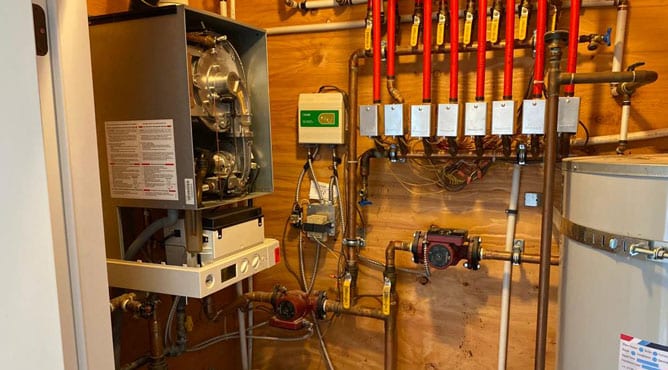
Take photos only from a safely accessible position, with covers fitted. Include nearby pipework and usable space if practical. The photo supports the discussion; it does not replace on-site measurements or prove that an existing component can be reused.
Why choose a clear installation scope?
You should be able to explain why the proposed model fits your home and what work is included around it. Our assessment discussion focuses on those practical decisions, from the heat-load basis to service access. Ask for clarification whenever a component or a proposed change is unclear.
Keep the equipment model, design assumptions, approved work and handover information together. This makes it easier to compare proposals and gives the next service visit useful context. Brand recognition and a compact cabinet are only part of the decision.
Safety comes first. If you smell gas, stop, avoid ignition sources, leave the building and call FortisBC at 1-800-663-9911 or 911 from outside. If a CO alarm sounds or you suspect exposure, get everyone outside and call 911. For an active water leak, stay clear of hot surfaces and electrical hazards; do not remove appliance covers. Follow emergency-service instructions before any assessment.
Check current upgrade programmes.
Before ordering equipment, review the current FortisBC rebates and offers and any applicable CleanBC programme requirements. Eligibility depends on the programme, equipment and property. A proposed gas boiler installation does not automatically qualify. Confirm any pre-approval, product listing and documentation before relying on an incentive.
Installation questions to settle before booking.
Can a new boiler work with my existing radiators in New Westminster?
Possibly. The assessment needs to establish radiator output, condition, required water temperatures and the connected piping. Useful existing components may be retained when compatible; replacement equipment should not be selected from the old boiler rating alone.
Is a combi boiler the right choice for a busy household?
That depends on heating needs, simultaneous fixture use and the selected model’s hot-water delivery at the required temperature rise. Compare a combi with a heating boiler and separate storage before choosing the arrangement.
Which parts should be included with a new gas boiler?
The design should address circulation, expansion, air and dirt management, isolation, controls, drainage and safety components. The written scope should distinguish retained parts from replaced or newly added parts.
Do I need a hydronic permit for gas boiler installation in New Westminster?
The City guide requires permits for new hydronic systems and alterations or extensions, while distinguishing minor leak repairs and scheduled maintenance. Confirm the classification and required documents for your specific project with the City; gas-work permits are a separate check.
Will a wall-hung boiler fit a small mechanical area?
Cabinet dimensions alone are not enough. Allow for manufacturer clearances, valves, piping, venting, drainage and future service. A site measurement is needed before confirming the location.
Can a Queen’s Park boiler replacement use a new exterior vent?
The vent route needs a technical review and a check of any relevant heritage protection. Certain alterations may require City approval. Confirm the property classification and proposed exterior work before fixing the appliance location.
What should a strata owner confirm before ordering a boiler?
Establish who owns the equipment, whether it serves one unit or shared areas, and who approves changes to walls or common services. Arrange access, permitted work hours and any shared shutdown with the responsible strata contact.
How long will my heating be unavailable during installation?
The interruption depends on removal, piping, venting, supporting parts and the agreed project sequence. Ask for a scope-specific shutdown plan and inspection arrangements before work starts; a universal one-day promise is not reliable.
Bring the brief.
We’ll discuss the fit.
Share your property type, existing model and what you want to improve. We will discuss the next step for a gas boiler installation assessment in New Westminster.
FOLLOW SKYLIMIT IN GOOGLE
Make SkyLimit a Preferred Source
Add SkyLimit as a Preferred Source so Google can highlight our BC gas-fireplace and HVAC guidance more often for you in Top Stories, AI Overviews and AI Mode.
If the button does not load, open Google Preferred Sources settings.