
RICHMOND · MAINTENANCE & SERVICE RECORDS
Make service useful.Keep comfort on track.
Gas boiler service in Richmond should connect today’s inspection with the way your heating system actually operates. SkyLimit Heating and Gas can help you discuss a model-specific maintenance appointment, including your heating layout, hot-water equipment, access arrangements and previous service findings. The useful outcome is a clear record of what was checked and what needs attention next.
Listen to the service guide
Short audio summary · AI Voice Generator. Press play when you are ready.
Choose the right appointment first
A boiler can still produce heat while a maintenance task is overdue. Equally, an active fault needs more than a standard tune-up. Describe what has changed: a room that no longer warms, a new noise, an error display, a recurring pressure change or hot water that varies during use. The distinction helps define the visit before equipment is opened.
If the boiler has stopped, leaks repeatedly or cannot satisfy a heating demand, use our gas boiler repair in Richmond guide and request fault assessment. If you are planning a different system or replacing equipment, our gas boiler installation in Richmond page explains the decisions that belong to a replacement project.
If you smell gas, leave, avoid ignition sources and call FortisBC at 1-800-663-9911 or 911 from outside. If a carbon monoxide alarm sounds, get everyone outside and call 911. A normal-looking boiler display is not a reason to ignore an alarm.
A simple calendar for gas boiler service in Richmond
FortisBC recommends regular professional appliance maintenance. An annual appointment is a useful starting point, but the exact manufacturer’s schedule and earlier findings should determine the work. Arrange it before your busiest heating period when practical; do not postpone an existing fault just to keep an annual date.
Find the model and serial number, previous invoice or report, and any notes about changes since the last appointment. Say whether the boiler supplies heating only, an indirect hot-water tank or a combi hot-water function. Identify the person who can authorize additional work and clear safe access to the equipment.
Ask the technician to relate the inspection to the actual appliance and connected system. Discuss the difference between included maintenance, a recommended repair and an item that cannot be assessed without further access or testing. Approve additional work deliberately rather than assuming that every replacement is part of a service.
Keep the report in one place and note meaningful changes without removing covers or altering gas controls. A short record of when a symptom happens is more useful than repeated resets. Follow the manufacturer’s user guidance and ask for advice if a new issue appears.
For a rental property, choose one contact to collect the tenant’s observations and retain service records. For a home with separate heating zones, record the affected room or thermostat rather than describing the entire house as cold. This gives the next assessment a better starting point.
Build a service history you can use
A service report is most valuable when it explains the findings in context. It should distinguish completed work from a recommendation and identify any inspection limits. A test result without its operating conditions, model reference or interpretation can be difficult to compare later.
| System item | Useful record | Question to ask |
|---|---|---|
| Appliance identity | Brand, model, serial number and system arrangement | Which maintenance instructions apply to this equipment? |
| Combustion and venting | Relevant checks, test findings and observed concerns | Does anything require action before continued operation? |
| Hydronic circulation | Zone response, visible leakage and pressure-related findings | Is the issue at the boiler or elsewhere in the heating circuit? |
| Controls and hot water | Demand response, error history and applicable hot-water checks | Were both functions tested where this is a combi system? |
| Follow-up | Completed tasks, proposed work and unresolved limitations | What should be addressed now, and what can be monitored? |
Keep records when you change service providers or sell the property. They do not guarantee that no breakdown will occur, but they can prevent an important observation from disappearing between appointments. Photographs supplied with a report should identify the relevant component without implying that an entire concealed piping system was inspected.
Four inspection conversations
The following groups explain the scope to discuss with a qualified technician. They are not a do-it-yourself procedure or a promise that every boiler needs identical cleaning. Access, appliance design and manufacturer instructions determine which checks are appropriate.
Combustion, air supply and exhaust
Discuss burner and ignition condition, appropriate combustion testing, air intake and venting observations. Condensing and conventional appliances have different arrangements. Cleaning or adjustment should follow the applicable instructions and be followed by the necessary checks; a visual look alone does not establish every operating condition.
Heating water and circulation
Discuss the pump, expansion arrangement, visible connections and response of heating zones. Uneven warmth can involve a valve, control, emitter or circulation problem beyond the boiler. A blanket flush is not automatically the correct answer. The reason for water-side work should be explained before it is approved.
Controls and operating history
Describe thermostat demand, scheduling changes and intermittent symptoms. Error history is a clue rather than a parts order. Sensors, wiring and control behaviour should be interpreted together, with any changes recorded so the next visit can distinguish a new issue from an existing one.
Domestic hot water, where connected
A combi appliance has a domestic-water function as well as space heating. A heating boiler connected to an indirect tank uses another arrangement. Explain when a hot-water problem occurs and which outlets are affected. Domestic-water descaling and heating-circuit cleaning address different conditions and should not be sold as interchangeable tasks.
Plan around the Richmond building
The appointment should fit the property, not a stereotype about its neighbourhood. In a detached home, identify the boiler room and all connected zones, including any suite. In a townhouse, establish whether the appliance is individually owned and whether a vent or shared space requires coordination. In an apartment or commercial property, confirm whether the requested work concerns private equipment or a common plant.
For City Centre and Brighouse appointments, ask about parking, loading access, elevator arrangements and the person responsible for mechanical-room entry. In Steveston, Seafair, Broadmoor and Blundell, provide the actual appliance location and any access restrictions rather than assuming equipment is in a garage. For Hamilton or East Richmond, tell us about gates, site access and the correct entrance when booking.
A strata manager may need to coordinate authorization and affected occupants before a shared-system shutdown. If findings lead to regulated gas alterations, the contractor should confirm the applicable permit authority and scope. Richmond has municipal gas permitting; the responsible authority can differ for particular installations. Routine service and a replacement project should not be treated as the same administrative task.
| Richmond areas | Details to provide when booking |
|---|---|
| City Centre, Brighouse, West Cambie, Bridgeport | Private or shared equipment, building contact and access arrangements |
| Steveston, Seafair, Thompson, Terra Nova | Equipment location, heating zones and previous service records |
| Broadmoor, Blundell, Shellmont, Ironwood | Heating-only or combi arrangement and any connected hot-water tank |
| Hamilton, Cambie, East Richmond | Site entrance, authorization contact and any access restrictions |
Brands, service consumables and replacement parts
Tell us whether the appliance is Navien, Viessmann, IBC, Bosch, Rinnai or Super Hot, then provide its exact model and serial number. Brand names help identify the equipment family; they do not establish the correct maintenance procedure or prove that a particular part is available. Confirm the scope for your model when arranging the appointment.
A manufacturer’s maintenance instructions may specify seals or other consumables when particular components are opened. Other parts, such as pumps, sensors, ignition components and control boards, need a reason for replacement supported by inspection or testing. Ask whether the recommendation concerns a scheduled consumable, a confirmed fault or an unresolved diagnostic possibility.
- Match the appliance: confirm model, serial range and applicable part revision before ordering.
- Explain the finding: connect the proposed part to the observed condition rather than relying on an error code alone.
- Clarify approval: distinguish included consumables from additional repair work and any further testing.
- Verify operation: record relevant post-work checks and remaining concerns.
Our gas boiler parts guide explains why compatibility matters. For Navien equipment, the manufacturer’s NCB-H document library illustrates the importance of using documentation for the correct series. Do not use that series’ instructions for a different appliance simply because the logo matches.
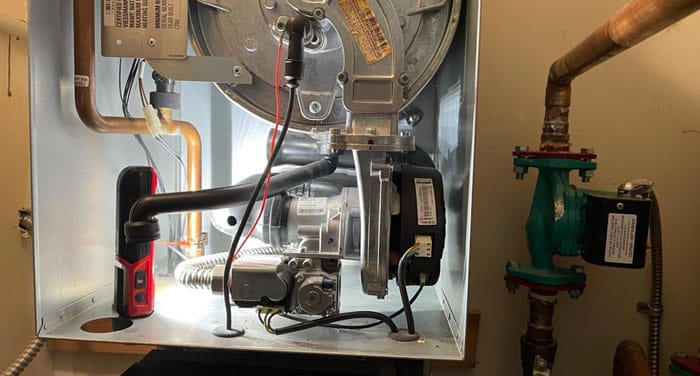
Why choose a clear service process?
When discussing an appointment with SkyLimit, ask for a scope that you can understand before work begins. You should be able to distinguish routine maintenance from a repair recommendation and know who will approve extra work. Model details and service records make that conversation more specific.
A practical explanation also acknowledges the limits of a visit. Servicing cannot promise a trouble-free season or a fixed reduction in fuel use. Weather, building heat loss, controls and hot-water demand affect consumption. If replacement becomes a consideration, compare the condition of the whole arrangement, repair findings and your future needs before choosing equipment.
For broader maintenance planning, see our gas boiler service guide. Keep the Richmond appointment focused on your actual system rather than adding tasks simply because they appear on a generic checklist.
Richmond boiler service: quick answers
How often should I arrange gas boiler service in Richmond?
Annual professional maintenance is a practical starting point, consistent with FortisBC guidance. Follow the exact manufacturer schedule and any additional requirements arising from operating conditions or previous findings. A current fault should be assessed when it happens rather than waiting for the next annual visit.
What should a boiler service report include?
Ask for the equipment identity, work completed, relevant test findings, items requiring follow-up and any limits on the inspection. Keep the report with previous records so changes in operation can be compared at the next visit.
Is maintenance the same as repairing a boiler that has stopped?
No. Routine service addresses scheduled inspection, cleaning and testing. A shutdown, recurring error, persistent leak or failed heating zone requires diagnosis. Tell SkyLimit about the fault when booking so the appointment can be scoped appropriately.
Does a combi boiler need its hot-water function checked too?
Yes. A combi boiler serves space heating and domestic hot water, so the appointment should consider both functions. Domestic-water maintenance and heating-circuit work are different tasks; any flushing or descaling must be justified by the model instructions and findings.
Can I book service for a boiler in a Richmond strata building?
First confirm whether the boiler is private equipment or part of a shared system. Arrange access, authorization and any required shutdown communication through the strata or property manager. Building responsibility cannot be determined from the apartment address alone.
Are parts automatically replaced during annual service?
No. Some models specify service consumables, while other components need replacement only when testing or inspection supports it. Ask which parts are included, which require approval and how model and serial-number compatibility will be checked.
Will servicing definitely reduce my gas bill?
No specific saving can be promised. Maintenance can identify issues affecting operation, but fuel use also depends on weather, thermostat settings, hot-water demand and the building. Compare consumption over suitable periods rather than treating one bill as proof of a boiler fault.
What should I do if I smell gas or my CO alarm sounds?
Leave the building and get everyone outside. For a gas smell, avoid ignition sources and call FortisBC at 1-800-663-9911 or 911 from outside. If a carbon monoxide alarm sounds, call 911 from outside. Do not wait for a routine service appointment or re-enter until cleared.
Start with your boiler details
Have the model, last service date, heating and hot-water arrangement, and access contact ready. Call SkyLimit to discuss the appropriate Richmond appointment and any symptoms that need separate diagnosis.
Reviewed October 3, 2026. Maintenance scope depends on the exact appliance, installation and findings.
FortisBC appliance maintenance guidanceTechnical Safety BC gas permit guidanceRichmond gas permit application
FOLLOW SKYLIMIT IN GOOGLE Add SkyLimit as a Preferred Source so Google can highlight our BC gas-fireplace and HVAC guidance more often for you in Top Stories, AI Overviews and AI Mode. If the button does not load, open Google Preferred Sources settings.Make SkyLimit a Preferred Source