
FIREPLACE COMPONENT GUIDE · BRITISH COLUMBIA
Gas Fireplace Glass Problems: Cracks, Black Soot, White Film, Fogging & Damaged Seals
Not every mark on gas fireplace glass means the glass has failed. Brief condensation on cold glass can be normal, while white film may be combustion residue. Black soot that returns quickly can point to an operating problem. A cracked, broken, loose, or improperly sealed glass front is different: stop using the fireplace and follow the manufacturer’s service requirements.
QUICK ANSWER
What Does the Appearance of Your Fireplace Glass Tell You?
Start by separating temporary condensation, removable residue, recurring soot, and physical glass damage. Regency notes that cold glass can briefly fog when the appliance is lit and that a white film can form from combustion-related condensation. By contrast, manufacturers warn against operating a fireplace with cracked or broken glass. The pattern matters more than simply calling the glass “dirty.”
GLASS SYMPTOM MATRIX
Dirty, Damaged or a Combustion Clue? Use the Pattern
| What You See | What It Can Mean | Best Next Step |
|---|---|---|
| Fogging for a few minutes after cold start | Temporary condensation can be normal | Observe whether it clears as glass warms |
| White/cloudy film | Combustion/curing residue may deposit on cooler glass | Clean only as manufacturer directs; do not let deposits bake on |
| Black soot | Possible combustion, burner, media/log placement, air or venting issue | Investigate cause, especially if soot returns quickly |
| Persistent etched haze | Deposits may have etched the surface | Model-specific assessment; cleaning may not restore clarity |
| Crack, chip or broken panel | Safety barrier/enclosure compromised | Do not operate; use approved replacement procedure |
| Loose glass / damaged gasket | Glass assembly may not seal as designed | Stop and have door/glass/gasket assembly checked |
IMPORTANT DISTINCTION
Gas Fireplace Glass Problems Are Not the Same as Glass Cleaning
This page is about diagnosing the glass assembly and the symptoms visible on it. A separate maintenance guide should handle routine cleaning instructions. If the deposit returns quickly or the window is damaged, a cleaning routine alone does not answer the repair question.
The glass can act like a diagnostic window. Recurring soot, unusual staining, a damaged seal, or a crack can tell you something about the appliance beyond appearance alone.
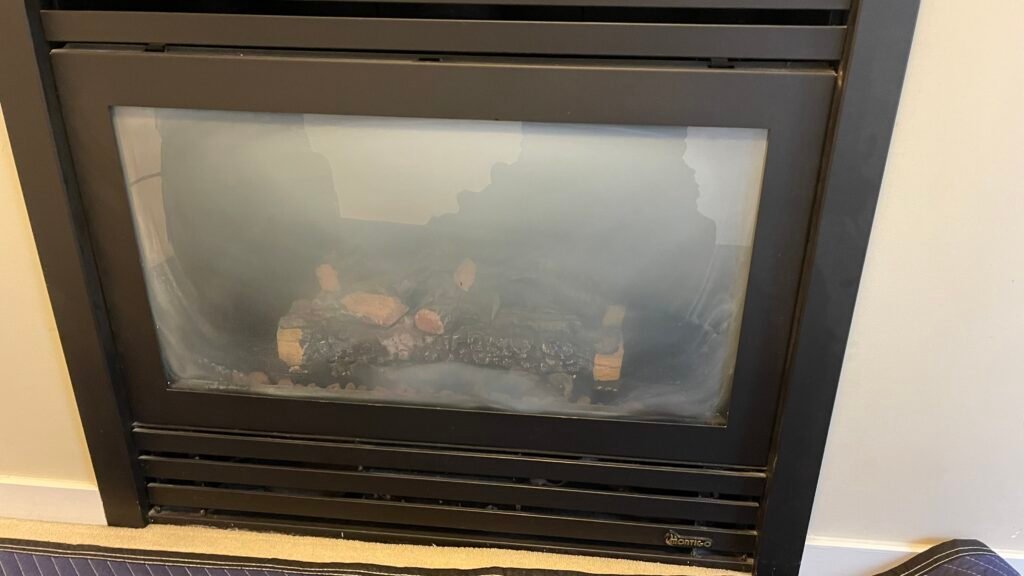
Why Does Gas Fireplace Glass Turn White or Cloudy?
Regency explains that a white film can develop on the inside of high-temperature fireplace glass. Water vapour mixed with combustion by-products can condense on the cooler glass surface and leave a deposit after drying. During initial break-in, curing of paint and logs can also contribute to film buildup.
This matters because the film is not merely cosmetic if it is ignored. Manufacturer guidance warns that deposits can become difficult to remove and may permanently etch the glass. Use only the cleaning method and product type approved for the specific fireplace, and never clean hot glass.
Why Does Fireplace Glass Fog Up When the Fire Starts?
Brief fogging is not automatically a defect. Regency documentation notes that when cold glass meets the conditions created after ignition, condensation can temporarily fog the glass and normally disappears as the glass heats.
The diagnostic distinction is duration and recurrence. Fogging that clears shortly after start-up is different from residue that remains after the fireplace is warm, water intrusion, or excessive condensation associated with venting conditions.
DON’T JUST WIPE THIS AWAY
Black Soot on Fireplace Glass Can Be a Symptom, Not a Cleaning Problem
FortisBC lists excessive soot and a yellow or wavering flame among signs that can indicate a gas-appliance problem. If black soot repeatedly returns after cleaning, especially alongside unusual flame appearance, delayed ignition, odour, or other abnormal operation, the useful question is why combustion is producing the deposit.
Potential causes vary by appliance and can involve burner condition, log or media placement, air openings, venting, gas pressure, or other combustion factors. Do not rearrange logs, glass media, or burner material unless the manufacturer’s instructions explicitly show the approved placement.
Continue to Gas Fireplace Burner Problems or the related Gas Fireplace Glass Gets Dirty Quickly symptom guide when recurring deposits are the main complaint.
Can You Use a Gas Fireplace With Cracked or Broken Glass?
No. Manufacturer guidance is explicit on this point. Regency states not to operate a fireplace without the glass front or with cracked or broken glass, and Valor likewise warns against operating an appliance with the glass front removed, cracked, or broken. The glass/window assembly must be properly in place and sealed before safe operation.
Replacement is also not a generic “cut a piece of glass to size” job. Fireplace manufacturers specify approved high-temperature glass/window assemblies, gaskets, and replacement procedures for the exact model.
Can a Glass Shop Make a Replacement Fireplace Window?
Matching the size alone is not enough. Do not substitute ordinary window glass or choose a panel solely because it is advertised as heat-resistant. The exact fireplace documentation determines the approved glass specification and whether replacement involves a pane, gasket kit or complete window assembly.
For example, Regency’s glass guidance directs owners to an authorized dealer for replacement after impact damage. Follow your appliance manufacturer’s repair path rather than assuming a custom-cut panel is acceptable.
Before approving the replacement, ask these questions
| Question | What the answer should clarify |
|---|---|
| Which model does this part fit? | The exact model and any serial-number or production revision requirements. |
| Is this a pane or an assembly? | Whether the quoted part includes the frame, gasket or hardware required by the model procedure. |
| What supports compatibility? | The manufacturer parts listing, service instructions or documented replacement guidance. |
| Why did the original glass break? | Whether impact, an assembly issue or an operating fault needs investigation before reuse. |
| What happens after installation? | Correct securing and sealing, replacement of required barriers and verification under the model instructions. |
A label such as “tempered” or “ceramic” is not a universal selection rule for every gas fireplace. Do not change glass type, thickness, frame or gasket based on a similar-looking appliance.
If the original part is unavailable
Ask for the documented manufacturer-supported alternative, if one exists. An unavailable panel does not authorize an improvised replacement. Keep the appliance off while the repair options are assessed; extensive assembly damage or lack of a supported repair path may require a replacement-appliance discussion.
Use the replacement part-number guide when a supplier offers a different number, and the glass, gasket and barrier guide when the affected piece is unclear. For diagnosis and a repair plan, request fireplace repair in Vancouver. Send photos of the front and model plate only if safely accessible; do not remove broken glass to measure it.
BC INCIDENT LESSON
A Broken Glass Panel Can Be the Result of a Deeper Fireplace Failure
Technical Safety BC has investigated gas-fireplace incidents in British Columbia where delayed or abnormal ignition produced enough pressure to shatter the front glass. In one Port Coquitlam incident, excess gas was introduced before ignition and the resulting ignition shattered the glass. In another direct-vent incident, unapproved media obstructed the burner and ignitor area and contributed to delayed ignition before the front glass shattered.
The practical lesson is important: when glass breaks during operation, or when the fireplace has been producing bangs, delayed ignition, abnormal flame behaviour, or other unusual symptoms, replacing the glass alone does not address the cause. The appliance needs diagnosis before it returns to service.
Technical Safety BC: Fireplace Glass Incident Investigation · TSBC: Delayed Ignition Investigation
What About a Loose Glass Door or Damaged Gasket?
The glass front is part of an engineered assembly. On applicable sealed fireplaces, the glass, door hardware, and gasket need to sit and seal as the manufacturer designed. A damaged gasket, disturbed door, incorrect replacement glass, or improperly secured panel should not be treated as a cosmetic issue.
If the problem appears to be around the seal rather than the pane itself, continue to Gas Fireplace Gasket Problems. If condensation, corrosion, or vent behaviour is involved, the next diagnostic path may be Gas Fireplace Vent Problems.
What Can a Homeowner Safely Observe?
- Whether fogging disappears after the glass warms.
- Whether residue is white/cloudy, brown, or black.
- Whether soot returns quickly after proper cleaning.
- Whether the flame looks unusually yellow, wavering, or contacts logs/media differently than before.
- Whether the glass has any crack, chip, impact mark, or loose edge.
- Whether the problem started after renovation, cleaning, media/log movement, or service.
- The fireplace brand, model, and serial number.
TECHNICIAN WORKFLOW
What We Check When Fireplace Glass Keeps Getting Dirty or Looks Damaged
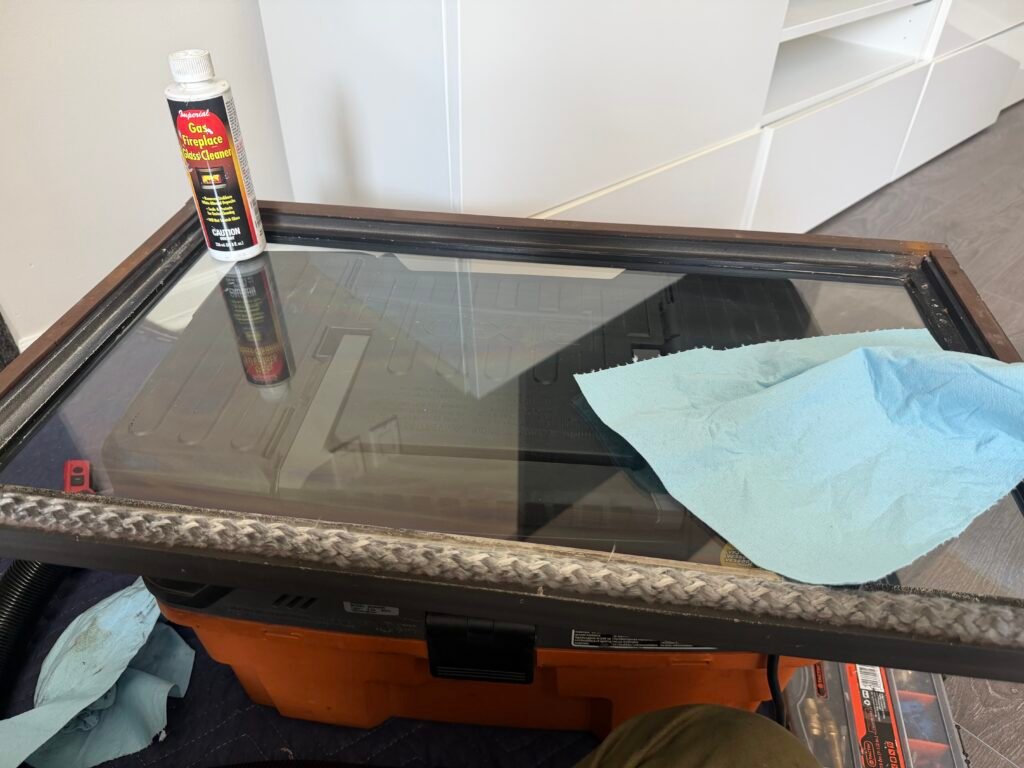
- Identify the exact fireplace and glass assembly. Replacement glass, gasket, latches, and door procedures are model-specific.
- Inspect the pane and seal. We look for cracks, chips, impact damage, loose hardware, gasket deterioration, and evidence that the assembly is not seated correctly.
- Read the deposit pattern. White film, black soot, localized staining, and recurring residue point in different directions.
- Inspect burner, media/log placement, ignition, and air openings. Glass symptoms can be downstream evidence of another problem.
- Inspect venting where indicated. Condensation, corrosion, or combustion concerns may require a broader vent assessment.
- Correct the cause before cosmetic cleanup. Cleaning glass without fixing recurring soot or abnormal ignition merely resets the evidence.
- Verify safe operation. After repair, the appliance should be reassembled and tested according to the manufacturer’s requirements.
INTERNAL DIAGNOSTIC PATH
Follow What the Glass Is Telling You
- Gas Fireplace Glass Gets Dirty Quickly — when recurring residue is the primary symptom.
- Gas Fireplace Burner Problems — when soot or flame pattern suggests a burner-side diagnosis.
- Gas Fireplace Gasket Problems — for loose, deteriorated, or suspect glass-door seals.
- Gas Fireplace Vent Problems — when condensation, corrosion, or venting symptoms are present.
- Gas Fireplace Igniter Problems — when delayed ignition or abnormal start-up accompanies glass concerns.
- Fireplace Repair Vancouver — professional repair path for Vancouver customers.
WHY SKYLIMIT HEATING
We Look Beyond the Glass Surface
When glass repeatedly soots, develops unusual deposits, loses its seal, or breaks, the correct repair is not always “replace the glass.” SkyLimit Heating evaluates the glass assembly together with the burner, ignition system, media/log placement, gasket, and venting conditions that can create or worsen the symptom.
FAQ · SEARCH-INTENT QUESTIONS
Gas Fireplace Glass Problems FAQ
Why is my gas fireplace glass turning black?
Black soot can indicate incomplete or abnormal combustion rather than a simple cleaning issue. Burner condition, log or media placement, air openings, venting, and other model-specific factors may need inspection.
Why is there a white film on my gas fireplace glass?
Manufacturer guidance explains that water vapour and combustion by-products can condense on cooler glass and leave a white film. It should be cleaned using the approved method before deposits become difficult to remove or etch the surface.
Is it normal for gas fireplace glass to fog when first turned on?
Brief condensation on cold glass can be normal and may disappear within a few minutes as the glass warms. Persistent moisture or unusual condensation deserves further investigation.
Can I use my gas fireplace with cracked glass?
No. Fireplace manufacturers warn not to operate an appliance with cracked, broken, removed, or improperly secured glass. Use the approved replacement assembly and procedure for the exact model.
Why does my fireplace glass get dirty again so quickly?
Rapid recurring deposits can mean the cause is not being corrected. The deposit colour and pattern, flame behaviour, burner, media placement, air supply, and venting can help narrow the problem.
Can ordinary window glass replace gas fireplace glass?
No generic substitution should be made. Gas fireplaces use manufacturer-specified high-temperature glass or complete window assemblies designed and certified for the appliance.
Can a damaged fireplace gasket affect the glass assembly?
Yes. On models that rely on a sealed glass-door assembly, the gasket and hardware must be in the condition and position specified by the manufacturer.
The Glass Is Often Evidence. Find the Cause Before It Returns.
If your gas fireplace glass is cracked, repeatedly turning black, developing stubborn haze, or no longer sealing correctly, SkyLimit Heating can inspect the glass assembly and the fireplace systems behind the symptom.