
FIREPLACE COMPONENT GUIDE · BRITISH COLUMBIA
Gas Fireplace Vent Problems: Blockages, Leaks, Condensation & Carbon Monoxide Risks
A fireplace vent problem is not always visible from the room. Depending on the appliance, the vent system must safely move combustion products outdoors and may also supply combustion air. Blocked, damaged, separated, incorrectly installed, or water-damaged venting can affect flame quality, create soot or condensation, damage the fireplace, and in serious cases contribute to carbon monoxide exposure or fire.
QUICK ANSWER
How Do You Know if a Gas Fireplace Has a Vent Problem?
Warning signs can include new soot or streaking, unusual condensation, corrosion, repeated pilot or burner problems, abnormal flame behaviour, odours, visible vent damage, or a change that began after exterior construction or renovation. FortisBC specifically advises homeowners not to block vents or pipes and lists excessive soot or damage on the vent system among signs that warrant professional attention.
VENT SYMPTOM MATRIX
Read the Symptom Before Blaming the Vent
| What You Notice | Possible Vent Connection | Also Check |
|---|---|---|
| Soot / dark streaks | Restricted combustion air or exhaust path may contribute | Burner, media/log placement, gas pressure |
| Persistent condensation / corrosion | Water entry, vent condition or installation issue possible | Termination, seals, building envelope |
| Pilot/burner repeatedly goes out | Draft or combustion-air issue can be one cause | Pilot, thermocouple/thermopile, controls |
| Problem after deck/siding/renovation | Termination clearance or recirculation may have changed | Exterior additions, air intakes, manufacturer clearances |
| Visible split/collapse/disconnection | Physical vent failure | Stop operation and assess entire vent path |
| CO alarm / occupants feel unwell | Potential combustion-product hazard | Treat as a safety issue, not DIY troubleshooting |
What Does a Direct-Vent Gas Fireplace Actually Do?
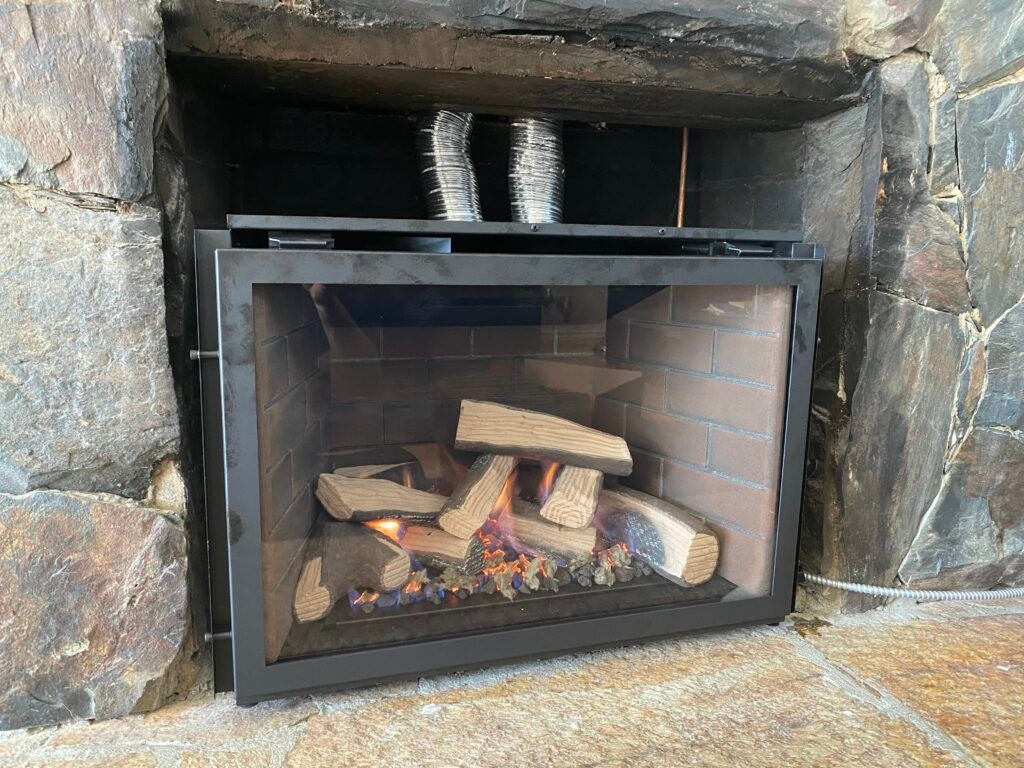
A direct-vent fireplace is designed to separate the combustion process from the room. Technical Safety BC describes direct-vent appliances as using enclosed passageways to bring combustion air from outdoors and send combustion products outdoors. Many systems use concentric venting, with one passage carrying exhaust and another supplying combustion air.
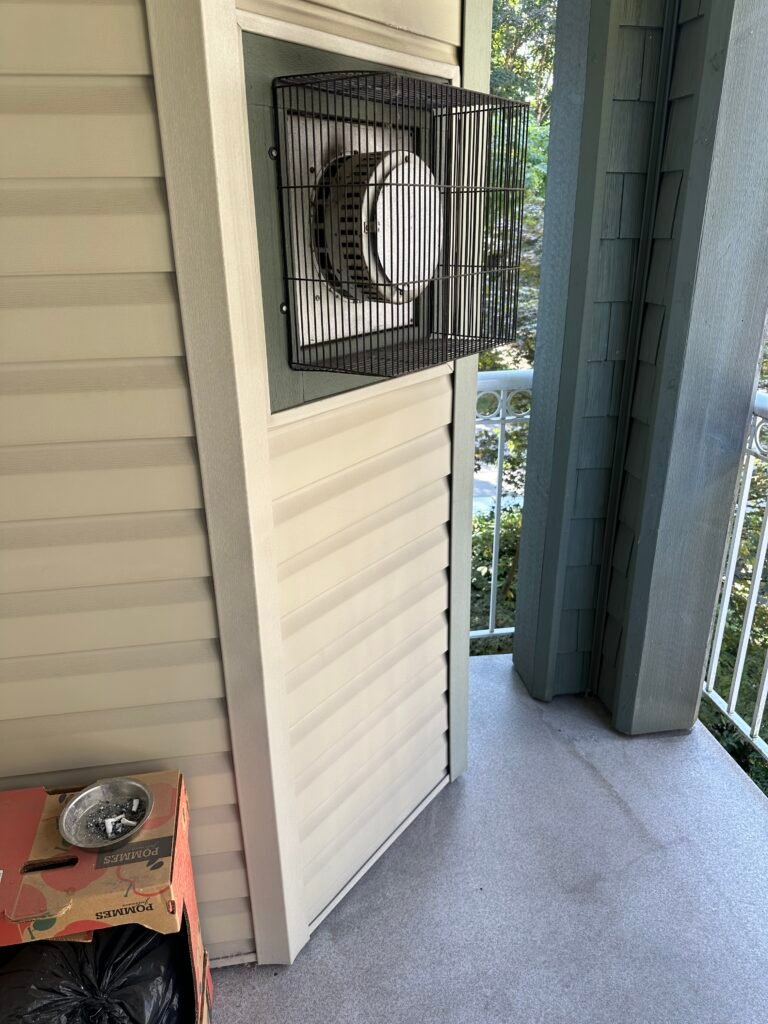
That is why the exterior termination is not decorative trim. Its position, clearances, integrity, and ability to move air as designed are part of the certified appliance system.
Common Gas Fireplace Vent Problems
1. Blocked or Restricted Termination
Debris, exterior objects, landscaping, construction, snow or other obstructions can interfere with an appliance vent or combustion-air path. FortisBC tells homeowners to keep appliance areas clear and not block vents or pipes. Any cleaning should remain within the owner-manual instructions and should not involve dismantling a certified vent system.
2. Incorrect Termination Location or Clearance
A vent can be open yet still be unsafe if exhaust is able to recirculate or if later construction changes the space around the termination. This is particularly important after decks, enclosures, siding work, additions, or changes to nearby air intakes.
3. Separated, Split or Damaged Vent Sections
Physical vent damage can allow heat or combustion products to reach areas where they do not belong. Water damage, installation defects, movement, corrosion, or mechanical damage can compromise a vent path.
4. Water Entry and Corrosion
Persistent moisture is different from brief condensation on cold fireplace glass. Water entering or damaging vent components can eventually compromise the system. Technical Safety BC investigated a Coquitlam fire where water damage caused a fireplace vent to collapse, allowing flue gases to accumulate in the building structure.
5. Incorrect or Unapproved Vent Configuration
Fireplace venting is model-specific. Diameter, components, maximum lengths, elbows, termination type, rise/run limits, clearances, and sealing methods come from the certified installation instructions. A physical fit does not establish that a component or configuration is approved for the appliance.
BC CASE STUDY · WHISTLER
Incorrect Vent Termination Led to Carbon Monoxide Exposure
In a 2025 Whistler investigation, Technical Safety BC reported that an incorrectly installed direct-vent termination on a free-standing gas fireplace allowed combustion products to recirculate into the appliance. The unsafe condition generated extremely high carbon monoxide levels, and combustion gases entered the living space. Two short-term renters sought medical attention for suspected CO exposure.
The value of this case is not to make every vent symptom sound catastrophic. It demonstrates something more useful: termination design and installation can affect combustion inside the appliance and indoor safety even when the vent is technically “outside.”
Technical Safety BC: Incorrectly Installed Fireplace Vent and CO Exposure
BC CASE STUDY · COQUITLAM
Water-Damaged Venting Contributed to a Fire Inside a Home
Technical Safety BC investigated a 2022 Coquitlam incident where a fireplace vent had been exposed to water damage and collapsed. Flue gases escaped into the wall and attic space, where a fire developed. This is a useful reminder that corrosion, water staining, or moisture around a fireplace or vent should not automatically be dismissed as a cosmetic building-envelope problem.
Water After Rain or Startup Condensation: Which Should You Report?
Brief fog on cold glass at startup can be different from water appearing after rain. Drips, pooling, water stains or corrosion need assessment; they do not establish whether the source is the vent, the termination or the surrounding building. Do not run a water-damaged fireplace to dry it out or prove that it still works.
Compare the timing and location
- Fog forms when the cold fireplace first lights
- Regency explains that startup condensation on cold glass can clear as the glass warms. Check your own model manual. This explanation does not cover dripping water, persistent moisture or a change accompanied by soot or abnormal operation.
- Water appears during or after rain, including while the unit is off
- Record where the moisture first appears and whether it follows wind-driven rain. The repair enquiry may need both an appliance/vent assessment and investigation of the building envelope. A wet area inside does not identify the outdoor entry point.
- Stains or rust remain after the surface dries
- Drying does not confirm that hidden vent sections are sound. Technical Safety BC documented a Coquitlam incident in which water damage contributed to vent collapse. Visible staining is a reason to report the history, not proof that your home has the same defect.
Make a short moisture record
- When: after rain, only at startup, or while the fireplace was off.
- Where: glass surface, firebox, lower compartment, surround, wall or ceiling.
- What changed: recent roofing, siding, deck work or previous vent service.
- What remains: staining, corrosion, dripping, odour or an operating fault.
Photograph accessible areas with the fireplace off and cool. Avoid roof access, opening walls or taking vent sections apart. Do not add a cover, drill a drain hole or seal the termination with a household product; the vent must retain its approved configuration.
Read Regency’s condensation guidance and the Technical Safety BC water-damaged vent investigation for the distinction. For window-only symptoms, use gas fireplace glass problems. For abnormal shutdowns or moisture affecting the appliance, request fireplace repair in Vancouver; confirm service availability for other addresses when contacting us.
Can a New Deck, Addition or Renovation Create a Vent Problem?
Yes. The appliance may not have changed, but the building around its termination can. Technical Safety BC has documented a BC carbon monoxide incident where a large deck constructed near appliance vents prevented exhaust gases from dissipating normally; an HRV intake then drew those gases into the home.
That case involved other gas appliances rather than a fireplace-specific failure, but the building-science lesson applies broadly: changes around an exterior gas-appliance termination or nearby air intake can alter how exhaust disperses. After exterior renovations, confirm that certified clearances and termination conditions remain intact.
Technical Safety BC: Exterior Construction and CO Recirculation Case
Can a Vent Problem Make Fireplace Glass Black?
It can be one possible contributor, but black glass does not prove the vent is blocked. FortisBC identifies yellow or wavering flame, excessive soot, and damage or streaking on a vent system as warning signs of gas-appliance trouble. Burner contamination, incorrect media/log placement, gas pressure, and other combustion issues can create similar symptoms.
That is why the correct path is symptom-based diagnosis rather than replacing random components. For deposit-specific diagnosis, see Gas Fireplace Glass Problems. For burner-side symptoms, continue to Gas Fireplace Burner Problems.
CARBON MONOXIDE
Why Vent Problems and Carbon Monoxide Need to Be Taken Seriously
Carbon monoxide is colourless and odourless, so smell is not a reliable warning. A vent or combustion problem can create conditions where combustion products are not handled as designed. FortisBC lists nausea, headache, lethargy and other flu-like symptoms as potential signs of CO exposure and recommends professional attention for abnormal gas-appliance symptoms.
If a CO alarm activates or people in the home develop possible CO symptoms, treat that as a safety event rather than continuing to run the fireplace to “see if it happens again.” Follow your alarm, emergency-service, utility, and local safety instructions.
SAFE HOMEOWNER OBSERVATIONS
What Can You Check Without Taking the Vent Apart?
- Note whether the symptom began after exterior renovation, roofing, siding, deck work, landscaping, or a storm.
- From a safe accessible location, observe whether the exterior termination is visibly obstructed or damaged.
- Look for new white, brown, or black streaking, corrosion, or water staining around accessible areas.
- Note whether fireplace glass develops unusual soot or persistent condensation.
- Record whether the pilot or burner shuts down repeatedly or flame behaviour has changed.
- Find the appliance model and installation manual so the correct vent system can be identified.
TECHNICIAN WORKFLOW
What We Check When a Gas Fireplace Vent Problem Is Suspected
- Identify the exact appliance and certified vent system. We start with the model and manufacturer requirements rather than generic vent dimensions.
- Reproduce the operating complaint. Flame, ignition, shutdown, condensation, soot and other symptoms are observed in context.
- Inspect accessible vent components and termination. We look for obstruction, separation, corrosion, water damage, installation defects and altered surroundings.
- Check the combustion side of the fireplace. Burner, media/log placement, ignition and air openings can create symptoms that resemble vent faults.
- Assess safety implications. Where conditions warrant it, combustion and CO-related checks become part of the diagnostic process.
- Correct the underlying defect using approved components and procedures.
- Run-test the fireplace after repair. Safe operation must be verified rather than assumed because a visible defect was fixed.
Vent Problem or Another Fireplace Component?
A fireplace that shuts down, soots, struggles to light, or behaves differently in certain weather can lead to several diagnostic paths. The vent should be investigated when evidence points there, but it should not become the default explanation for every symptom.
- Gas Fireplace Glass Problems — black soot, white film, condensation, cracks and glass-seal symptoms.
- Gas Fireplace Burner Problems — abnormal flame and burner-side combustion symptoms.
- Gas Fireplace Pilot Assembly Problems — pilot outages and unstable pilot flame.
- Gas Fireplace Igniter Problems — clicking, no spark, delayed ignition and spark-related faults.
- Gas Fireplace Gasket Problems — glass-door and firebox sealing concerns.
- Fireplace Repair Vancouver — professional repair path for Vancouver customers.
WHY SKYLIMIT HEATING
A Vent Inspection Should Follow the Fireplace, the Building and the Symptom
SkyLimit Heating evaluates vent concerns as part of the complete fireplace system. That means matching the vent to the exact appliance, looking at the exterior termination and surrounding building conditions, and checking whether burner, ignition, glass, gasket or media problems are producing symptoms that merely look like a vent fault.
FAQ · SEARCH-INTENT QUESTIONS
Gas Fireplace Vent Problems FAQ
How do I know if my gas fireplace vent is blocked?
Possible clues include new soot or streaking, abnormal flame behaviour, repeated shutdowns, condensation, corrosion, or a visibly obstructed termination. These symptoms are not proof of a blockage, so the appliance and vent should be diagnosed together.
Can a blocked gas fireplace vent cause carbon monoxide?
A venting or combustion-air problem can contribute to unsafe combustion or prevent combustion products from being handled as designed. CO is colourless and odourless, so an alarm or possible exposure symptoms require immediate safety action rather than DIY testing.
Can a deck or renovation affect a fireplace vent?
Yes. Exterior construction can change termination clearances or how exhaust disperses around a building. After renovations near a gas-appliance vent, the installation should still meet the appliance manufacturer’s certified requirements.
Why is there water or corrosion around my fireplace vent?
Water staining or corrosion can involve weather exposure, termination issues, seals, building-envelope conditions, or vent deterioration. Persistent moisture deserves investigation because water damage can compromise vent components.
Can a vent problem make gas fireplace glass turn black?
It can be one contributor, but black glass can also result from burner, media placement, gas-pressure, or other combustion problems. The soot pattern and complete appliance operation should be assessed.
Can I repair or reseal fireplace vent pipe myself?
Do not improvise repairs to a certified gas-fireplace vent system. Vent components, joints, sealing methods, clearances and terminations are model-specific and regulated gas work may require a qualified licensed contractor in British Columbia.
How often should gas fireplace venting be inspected?
Follow the appliance manufacturer’s maintenance schedule. FortisBC notes that fireplace service should include inspection of venting and air openings, along with the burner, gas valve, ignition system and door gaskets.
A Vent Problem Can Hide Behind an Ordinary Fireplace Symptom
If your fireplace has recurring soot, condensation, corrosion, shutdowns, unusual flame behaviour, visible vent damage, or problems that began after exterior construction, SkyLimit Heating can inspect the fireplace and vent system to identify the actual cause.