
What Are the Signs of a Gas Fireplace Burner Problem?
Common warning signs include partial burner ignition, delayed ignition or a “whoosh,” flames that suddenly look different, recurring black soot, flame lifting, unusual burner noise, or a burner that lights on one side but not the other. A burner problem should not be diagnosed from flame appearance alone because log placement, pilot alignment, venting, gas supply, and model-specific air settings can change combustion.
SYMPTOM DASHBOARD
What Is Your Burner Doing?
Only Half the Burner Lights
Blocked burner ports, crossover issues, contamination, or ignition-path problems may be involved.
Burner Ignites With a Pop
Delayed ignition needs attention. Pilot position, burner condition, or ignition transfer may be wrong.
Black Soot Appears
Improper combustion, log placement, blocked ports, venting, or fuel-air conditions may be responsible.
Flames Look Weak
Gas supply, burner contamination, controls, or model-specific operating conditions should be checked.
Flame Lifts From Burner
Do not start adjusting air shutters blindly. Fuel, pressure, venting, or setup can affect flame stability.
Burner Does Not Light
The burner itself may be fine. Pilot, gas valve, thermopile, switch, receiver, or ignition control may be upstream.
UNDER THE LOG SET
What Does the Gas Fireplace Burner Actually Do?
The burner receives gas from the appliance control system and distributes it through precisely arranged ports. Those ports are designed to create a particular flame pattern around the logs, media, or firebox. The burner, pilot, log set, venting system, and gas controls are therefore not independent pieces. They operate as one engineered combustion system.
That matters when diagnosing a flame complaint. A homeowner may see blackening on one log and assume the burner is failing. In reality, a log that has shifted into the flame path can disturb combustion. Likewise, a clean burner may still ignite poorly if the pilot flame no longer reaches the intended ignition area.
The useful question is not “Does the flame look strange?” It is “What changed in the ignition, gas distribution, media placement, or combustion system to make the flame behave differently?”
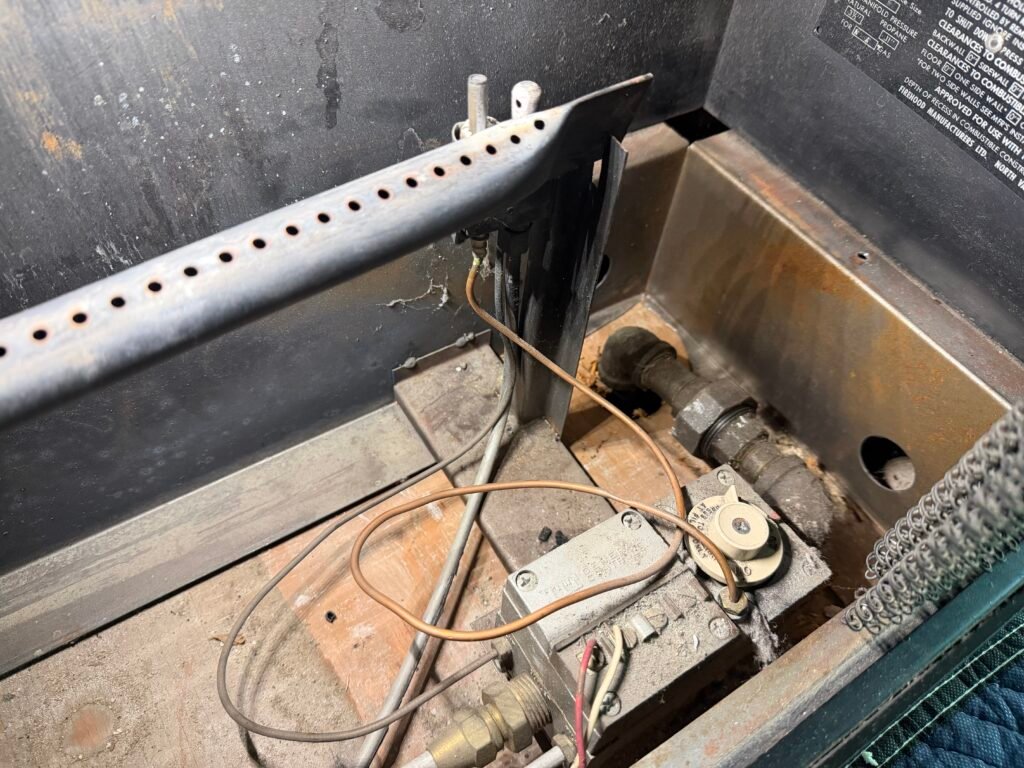
Close-up of gas fireplace burner ports and crossover ignition area
CAUSE → EFFECT
8 Common Causes of Gas Fireplace Burner Problems
1. Dust and Debris in Burner Ports
Fine debris can affect gas distribution through the burner. The result may be uneven flame, slow flame travel, or sections of the burner that do not light as expected.
2. Blocked Crossover or Ignition Area
Many burners rely on a designed path for flame to move from the ignition point across the burner. Contamination in that area can contribute to incomplete or delayed ignition.
3. Pilot Flame Is Not Reaching the Burner Correctly
A burner may be perfectly serviceable but ignite poorly because the pilot flame is weak, distorted, or misdirected. Continue with our Gas Fireplace Pilot Assembly Problems guide when the ignition flame itself looks questionable.
4. Incorrect Log or Media Placement
Ceramic log placement is part of the model-specific fireplace setup. Their positions are specified by the manufacturer because incorrect placement can interfere with flame paths and contribute to soot.
5. Burner Damage or Corrosion
Age, moisture, contamination, or physical damage can affect burner surfaces and ports. The correct response depends on the burner design and manufacturer service instructions.
6. Gas Pressure or Supply Problem
Incorrect operating pressure or supply conditions can affect flame size and burner performance. Gas pressure diagnosis requires proper instruments and model specifications.
7. Gas Valve or Control Problem
If gas flow to the burner is not being controlled correctly, the burner symptom may originate upstream. See Gas Fireplace Gas Valve Problems before assuming the burner itself has failed.
8. Venting or Combustion-Air Problem
Flame appearance is affected by the complete combustion system. A venting restriction, incorrect configuration, or other air-flow issue can create symptoms that cleaning the burner alone will not solve.
Can I Move the Logs or Add Fire Glass for a Better Flame?
Only use the media and arrangement approved for your exact fireplace. A kit sold for a different model, outdoor burner or another fuel setup is not automatically suitable. Do not add stones, glass or extra embers, or move logs into a new pattern, simply to change the appearance.
Technical Safety BC investigated a White Rock fireplace in which substituted media covered the burner and ignitor. Delayed ignition followed and the front glass shattered. The official investigation shows why a decorative change can affect the ignition system.
Three questions before a media change
- Is the proposed set listed for this model? Ask for the manufacturer’s accessory or replacement listing. Brand name alone does not establish compatibility.
- Is there an installation diagram? The instructions should establish the layout, permitted quantity and areas that must remain clear. A photo of another fireplace is not a substitute.
- Who will verify the finished setup? Discuss the required installation and operating checks before approving the work.
The flame changed immediately after cleaning or moving logs
Keep the fireplace off if it now has delayed ignition, a bang, heavy soot or abnormal flame behaviour. Tell the technician what moved and when. Do not repeatedly rearrange the pieces and restart the unit to find a pattern that looks better.
A seller describes the media as “universal”
Request documented approval for your appliance before purchasing. Heat resistance, colour and physical size do not establish compatibility with the complete fireplace design. If documentation is unavailable, do not install it as an experiment.
Useful information for the assessment
Send the model number, a photo taken through the intact glass while the unit is off and cool, and the packaging or part number of any added material. Describe whether ignition, flame or deposits changed after the alteration. Do not remove the glass or restart an abnormally operating fireplace just to make a video.
For soot following a layout change, see gas fireplace glass turning black. If ignition became delayed, use the gas fireplace igniter problems guide to understand the diagnosis, or request fireplace repair in Vancouver.
A “Whoosh” or Bang at Ignition Is Not Normal
When gas begins flowing before flame reaches the intended burner area, ignition can be delayed. The eventual ignition may sound like a pop, thump, or whoosh. Repeated delayed ignition needs diagnosis before further use.
Possible contributors include:
- Weak or incorrectly positioned pilot flame
- Blocked burner ignition ports
- Contaminated crossover area
- Incorrect burner or log configuration
- Gas pressure or control problems
- Model-specific venting or combustion issues
If ignition is delayed, turn the fireplace off and arrange professional diagnosis rather than repeatedly cycling it to “see if it gets better.”
FLAME & COMBUSTION
Why Is My Gas Fireplace Burner Making Black Soot?
Some flame coloration and deposits depend on fireplace design, but recurring heavy black soot deserves investigation. The location of the soot can provide useful clues. Blackening concentrated where flame strikes a misplaced log suggests a different path than widespread soot combined with abnormal flame behaviour.
Potential causes include incorrect log or media placement, restricted burner ports, incorrect air-fuel conditions, venting problems, burner damage, or model-specific setup issues.
Do not “fix” soot by randomly opening an air shutter.
Air adjustments are appliance-specific. Changing one setting without verifying fuel type, pressure, venting, burner condition, and manufacturer specifications can hide one symptom while creating another.
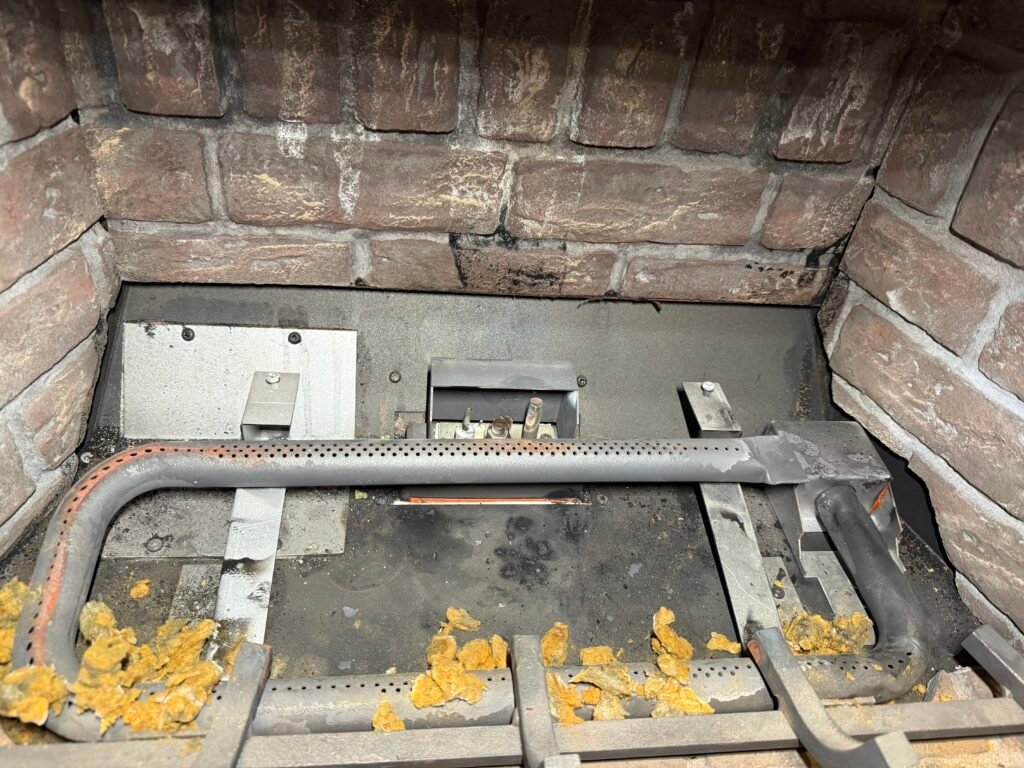
IMPORTANT DISTINCTION
The Burner Won’t Light, but the Burner May Not Be the Problem
If no gas is being delivered to the main burner, cleaning burner ports will accomplish remarkably little. The diagnostic path needs to move upstream through the fireplace control system.
| What You See | What Else to Check |
|---|---|
| Pilot is lit, burner is dead | Thermopile, switch, receiver, wiring, gas valve |
| Pilot will not stay lit | Pilot flame, thermocouple, pilot safety circuit |
| Electronic fireplace keeps sparking | Igniter, flame sensing, module, pilot gas |
| Burner shuts off after warming | Controls, thermopile, receiver, wiring, safety or venting conditions |
Related diagnostic pages: Thermopile Problems, Gas Valve Problems, and Gas Fireplace Won’t Turn On.
BEFORE SERVICE
Safe Things a Homeowner Can Check
- Observe the flame pattern without disassembling the fireplace. Note whether ignition starts at one side, whether the entire burner lights, and whether soot returns.
- Look for obviously displaced logs. Do not rearrange them unless you have the exact manufacturer placement diagram.
- Record when the symptom happens. Cold start, warm restart, windy weather, and long operating cycles can provide useful diagnostic clues.
- Take a clear photo while the fireplace is off and cool. Describe previously observed behaviour; do not restart an abnormal fireplace to record it.
- Find the model and serial information. This helps identify the correct burner layout and service documentation.
poking burner ports with drill bits or needles, changing gas-pressure adjustments, modifying air shutters without specifications, moving logs randomly, or operating a fireplace that repeatedly ignites with a bang.
TECHNICIAN WORKFLOW
How We Diagnose Gas Fireplace Burner Problems
Step 1 — Identify the Fireplace
The model, fuel type, burner design, log placement, ignition system, and manufacturer specifications establish what “normal” should look like.
Step 2 — Watch a Cold Ignition
We observe pilot ignition, flame transfer, burner light-off, timing, sound, and initial flame distribution.
Step 3 — Inspect Burner and Media
Burner ports, crossover areas, logs, embers, media, physical damage, contamination, and burner position are checked.
Step 4 — Check the Upstream System
Pilot assembly, gas valve, thermopile or electronic controls, and other relevant components are tested when the symptom points upstream.
Step 5 — Evaluate Combustion Conditions
Gas pressure, venting, flame characteristics, and model-specific air settings are evaluated where appropriate.
Step 6 — Repair and Verify
After corrective work, the fireplace is run through ignition and operating cycles to confirm smooth burner light-off and stable operation.
REPAIR PATH
Cleaning, Repair, or Burner Replacement?
Clean & Correct
Appropriate when contamination or incorrect media placement is responsible and the burner remains serviceable.
Repair Related Component
The burner may need no replacement if the real fault is the pilot, valve, control circuit, or ignition system.
Replace Burner
Replacement may be appropriate for confirmed physical damage, corrosion, or a manufacturer-directed failure using the correct approved part.
BC GAS SAFETY
Burner and Combustion Work in British Columbia
Gas burner diagnosis can involve regulated gas components, gas pressure, combustion, venting, and appliance setup. For work beyond normal homeowner maintenance, use appropriately qualified gas professionals and follow the appliance manufacturer’s instructions.
FIREPLACE DIAGNOSTIC PATH
Related Guides for the Same System
- Gas Fireplace Pilot Assembly Problems — when the pilot flame or ignition point looks wrong.
- Gas Fireplace Gas Valve Problems — when pilot is established but main burner gas flow is questionable.
- Gas Fireplace Thermopile Problems — for millivolt burner-control problems.
- Gas Fireplace Thermocouple Problems — when a standing pilot will not remain established.
- Gas Fireplace Turns Off After a Few Minutes — for heat-related shutdowns.
- Fireplace Repair Vancouver — professional diagnosis and repair.
WHY SKYLIMIT HEATING
Diagnose the Flame Pattern, Not Just the Burner
Burner complaints are often system complaints in disguise. SkyLimit Heating checks the ignition path, pilot assembly, burner, logs or media, gas controls, and relevant combustion conditions before recommending parts.
FAQ
Gas Fireplace Burner Problems FAQ
Why does only half of my gas fireplace burner light?
Possible causes include restricted burner ports, contamination in the crossover or ignition area, poor pilot alignment, or another issue affecting flame transfer across the burner.
Why does my fireplace make a bang when it lights?
A pop, bang, or strong whoosh can indicate delayed ignition. Pilot position, burner ignition ports, crossover areas, gas conditions, log placement, or other model-specific factors should be inspected.
Can a dirty burner cause black soot?
It can contribute, but soot can also result from incorrect log placement, combustion-air conditions, venting, gas pressure, or other setup problems.
Can I clean gas fireplace burner holes with a needle?
Do not enlarge or modify burner ports with drill bits, needles, or similar tools. Burner service should preserve the manufacturer-designed port size and configuration.
Why is my burner flame suddenly different?
Changes can come from burner contamination, shifted logs or media, pilot conditions, gas supply, venting, controls, or other appliance-specific conditions.
Does a burner need replacement if it is rusty?
Not every surface change means replacement is required. The burner should be inspected for the type and extent of corrosion or damage and evaluated against manufacturer service requirements.
Can a bad gas valve cause burner problems?
Yes. If the gas valve or its control circuit does not provide the required burner gas flow, the symptom can appear to be a burner failure even when the burner itself is serviceable.
Do you repair gas fireplace burner problems in Metro Vancouver?
SkyLimit Heating diagnoses burner, pilot, ignition, gas valve, thermocouple, thermopile, control, and related fireplace problems across Metro Vancouver and the Fraser Valley.
PROFESSIONAL FIREPLACE DIAGNOSIS
Uneven Flame, Soot, or Delayed Burner Ignition?
We can inspect the burner, pilot assembly, logs or media, gas valve, ignition controls, and operating conditions to find the cause before replacing parts unnecessarily.