
Gas Fireplace Turns Off After a Few Minutes? Causes, Safe Fixes & Professional Repair
A gas fireplace that lights normally and then shuts down after several minutes is usually reacting to a weak flame-sensing signal, restricted airflow, overheating, a control problem, a venting concern, or even a service issue. By servicing your fireplace, you can also get a Fortis rebate. The pattern matters. Avoid replacing parts until the failure point has been identified.
Serving Metro Vancouver and the Fraser Valley • Licensed gas technicians • Safety-focused diagnosis
Quick Answer
If your gas fireplace turns off after a few minutes, the most likely causes are a dirty or unstable pilot flame, a weak thermopile or thermocouple, an overheating safety switch, restricted venting, a failing gas valve, loose control wiring, or an issue with the receiver, thermostat, or remote system. You can safely check batteries, airflow around the unit, visible vent obstruction, and the shutdown pattern. Do not adjust the gas valve, bypass safety switches, dismantle the pilot, or continue restarting a fireplace that smells like gas, produces soot, or causes headaches or nausea.
Key Takeaways
It is usually repairable
Many intermittent shutdowns are caused by serviceable pilot, sensor, control, airflow, or maintenance issues.
Timing is diagnostic
A unit that fails after the same warm-up period often points toward a heat-related electrical or safety-control problem.
Shutdown may be protective
The fireplace may be closing the gas valve because a required safety signal has dropped below its operating threshold.
Testing beats guessing
Millivolt readings, flame observation, vent inspection, and warmed-up testing are more useful than swapping parts at random.
What This Problem Usually Looks Like
The exact sequence helps narrow the diagnosis. Before the appointment, note whether the pilot remains on, whether the main burner goes out, how long the fireplace runs, and whether it restarts immediately or only after cooling.
Starts normally, then stops
The main burner lights with a normal flame, runs for five to thirty minutes, and shuts off without anyone touching the controls.
Pilot stays on
The burner goes out, but the pilot remains lit. This may indicate a thermopile, gas valve, switch, receiver, or wiring issue.
Pilot also goes out
When both pilot and burner stop, the pilot assembly, thermocouple, venting, gas supply, or safety system deserves closer inspection.
Restarts after cooling
A fireplace that works again after ten or twenty minutes may be reacting to heat, restricted airflow, a high-limit switch, or a warm-component voltage drop.
Only fails on windy days
Wind-related failures may involve the vent termination, pressure balance, damaged vent components, or flame disturbance.
Remote appears random
If the shutdown seems unpredictable, batteries, receiver contacts, wall-switch wiring, thermostat programming, or radio-frequency interference may contribute.
Technician Observation
A pilot flame can look acceptable to a homeowner and still be too weak, poorly directed, or unstable to heat the sensing components correctly. We look at flame shape, contact point, stability, and performance after the fireplace has fully warmed up. A brief visual inspection alone is not enough to diagnose an intermittent shutdown.
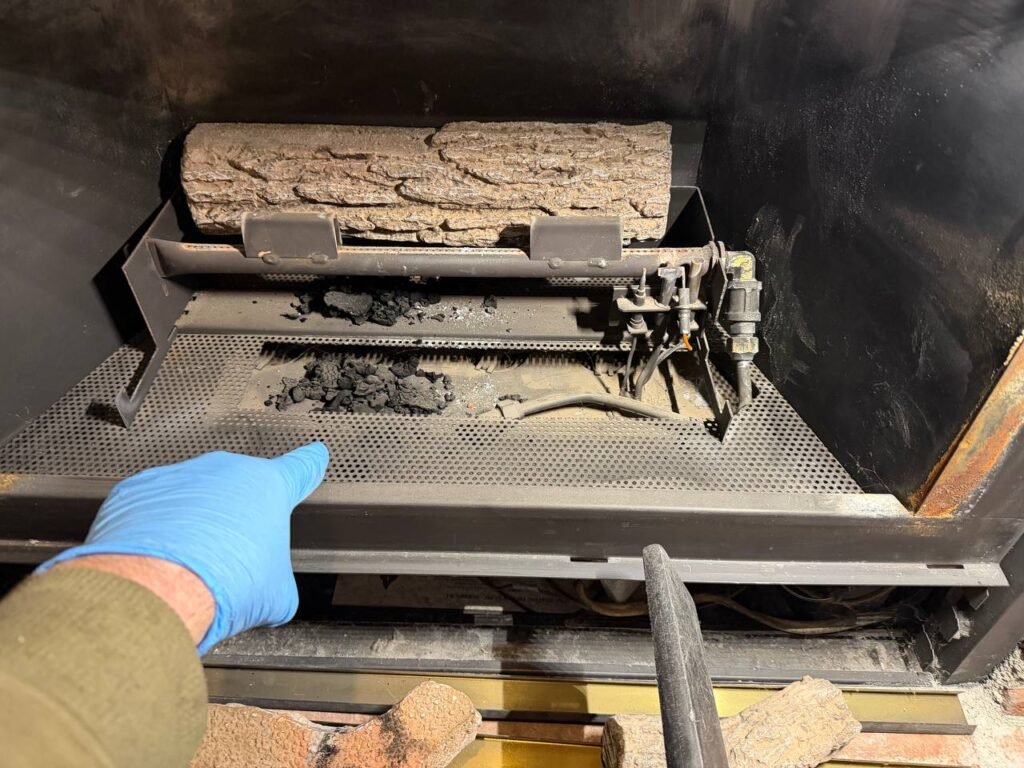
10 Common Causes of a Gas Fireplace Shutting Off
Dirty or restricted pilot assembly
Dust, lint, pet hair, renovation debris, and combustion residue can reduce pilot flow. The fireplace may ignite while cold, but the flame can become unstable or fail to heat the sensor correctly during operation. Proper cleaning requires care because pilot openings are precisely sized and can be damaged by improvised tools.
Weak thermopile
A thermopile converts heat from the pilot flame into a small electrical output used by the control circuit. An aging thermopile may produce enough voltage to start the fireplace but not enough to keep the gas valve energized under load, especially after the unit warms up.
Failing thermocouple
On standing-pilot systems, the thermocouple helps confirm that a pilot flame is present. If its signal weakens, the safety system may close the gas supply. This can cause pilot outages, burner shutdown, or a fireplace that behaves differently from one cycle to the next.
Restricted or damaged venting
Leaves, nests, snow, construction debris, damaged caps, incorrect termination clearances, or disconnected vent components can disturb combustion and pressure balance. Venting problems are not a do-it-yourself experiment. They can create carbon monoxide and combustion-safety concerns.
Overheating or high-limit activation
Blocked louvres, dust buildup, an inoperative blower, incorrect decorative media placement, restricted convection airflow, or internal component problems can raise appliance temperature. A high-limit or thermal switch may then interrupt operation until the fireplace cools.
Loose or heat-sensitive wiring
Switch wires, receiver leads, terminal connections, and control contacts can loosen, corrode, or change resistance as they warm. A circuit that works while cold may open after heat expansion, making the fireplace shut off and later restart.
Wall switch, thermostat, or receiver problem
A worn wall switch, weak remote batteries, failing receiver, poor battery contact, or thermostat schedule can interrupt the call for heat. These are simple possibilities, but they should not be blamed until pilot and safety performance are also considered.
Gas valve failure
A gas valve can become unreliable under operating temperature or electrical load. Because gas valves are safety-critical components, they should be evaluated with proper measurements and manufacturer procedures rather than diagnosed by tapping, bypassing, or optimistic guesswork.
Ignition module or flame-sensing issue
Electronic ignition fireplaces use modules, electrodes, flame-rectification circuits, and wiring to prove flame. Contamination, weak grounding, cracked ceramic, poor sensor position, or module failure can cause the control to shut the burner down.
Gas pressure or supply problem
Improper inlet pressure, regulator trouble, a partially closed shutoff valve, undersized piping, or a supply issue may affect flame stability when the burner is operating. Gas pressure testing must be completed by a qualified gas technician.
Symptom-to-Cause Comparison
| Observed symptom | Possible causes | Best next step |
|---|---|---|
| Shuts off after nearly the same number of minutes | Weak thermopile, heat-sensitive wiring, high-limit switch, gas valve | Test the fireplace through a full warm operating cycle |
| Main burner stops, but pilot remains on | Thermopile, switch circuit, receiver, valve, thermostat | Measure loaded millivolts and inspect the control circuit |
| Pilot and burner both go out | Pilot restriction, thermocouple, venting, gas supply | Inspect flame quality, venting, and safety controls |
| Fails mainly during wind or severe weather | Vent termination, pressure balance, blockage, damaged vent | Stop repeated operation and arrange a vent inspection |
| Shuts down with blower noise or excessive cabinet heat | Airflow restriction, blower failure, thermal switch | Check clearances and arrange internal temperature testing |
| Random shutoff controlled by remote | Batteries, receiver, thermostat schedule, contacts, wiring | Replace approved batteries and document the pattern |
Normal Thermostat Cycling or an Unexpected Shutdown?
A burner turning off is not always a failed part. In thermostat mode, the control can stop the burner when the room reaches the selected temperature. An unexplained shutdown, failed restart or change from previous operation needs a different assessment. Compare the selected mode with the exact model’s instructions before assuming the thermopile or gas valve has failed.
The room reached the selected temperature
Check the room-temperature reading and target temperature on the remote. A thermostat may intentionally cycle the burner while maintaining comfort. Regency’s Proflame 2 guide describes this temperature-controlled operation for that system. Different controls have different modes and sequences, so do not apply its button instructions to another remote.
The fireplace stops before meeting the heat demand
Record whether the pilot remains lit, whether the remote still requests heat and whether there is an error indication. A technician needs to identify the control system and reproduce the failure safely. A pilot-only symptom on an electronic fireplace should not automatically be tested as a standing-pilot millivolt fault. Our pilot-on, burner-off guide explains that distinction.
Make a Shutdown Record Without Repeated Test Runs
- Before shutdown: note the mode, room and target temperatures, and elapsed operating time.
- At shutdown: note whether the main burner alone stops or the pilot also goes out.
- Control response: record any beep, flashing indicator or error message.
- Recent changes: include new batteries, a moved remote, power interruption or building gas work.
Do not keep restarting the unit to complete this list. If the remote settings are unclear, review gas fireplace remote troubleshooting. If shutdown remains unexplained, request fireplace repair in Vancouver and describe the sequence rather than requesting a particular replacement part.
Safe Checks You Can Perform
These checks are observational and external. They can provide useful information without opening the gas train or defeating any safety device.
Check batteries and control settings
Replace remote and receiver batteries with the type specified by the manufacturer. Confirm the receiver is set correctly and that thermostat schedules or timer functions are not turning the fireplace off.
Keep louvres and airflow paths clear
Remove objects, furniture, rugs, pet beds, and decorations that obstruct the lower or upper openings. Do not remove factory screens or panels while the unit is operating.
Observe the pilot and burner through the glass
Note whether the flame shrinks, lifts, flickers heavily, changes colour, or goes out just before shutdown. Do not open a sealed glass assembly to inspect a running fireplace.
Inspect the outside termination from a safe location
Look for obvious snow, leaves, nests, or debris without climbing, dismantling, or inserting tools. A damaged or blocked termination requires professional attention.
Record the timing
Write down how long the fireplace runs, whether the blower is on, whether the pilot remains lit, and how soon the unit can restart. This often saves diagnostic time.
Review the owner’s manual
Check approved operating instructions, battery requirements, reset procedures, and model-specific warnings. Avoid generic online procedures that may belong to a completely different control system.
Stop and Call a Professional When Safety Is in Question
Turn the fireplace off and avoid further operation if you smell natural gas, see heavy soot, notice delayed ignition or a booming sound, observe damaged glass or venting, or experience headache, nausea, dizziness, eye irritation, or unusual fatigue while the appliance operates.
- Do not bypass, jump, tape, or hold a safety switch closed.
- Do not adjust the gas valve or regulator.
- Do not loosen gas fittings or test for leaks with a flame.
- Do not drill, enlarge, or aggressively probe the pilot opening.
- Do not keep restarting a fireplace that repeatedly shuts down.
- Do not operate a sealed direct-vent fireplace with damaged or improperly fitted glass.
FortisBC recommends regular service by a licensed gas contractor and advises homeowners to call for professional help when they notice pilot outages, delayed ignition, unusual odours, soot, or possible carbon-monoxide symptoms.
How a Licensed Technician Diagnoses the Shutdown
Intermittent problems require the fireplace to be tested under the conditions that produce the failure. A cold-start inspection alone can miss a thermopile that weakens under load, a wire that opens as it heats, or a thermal switch that activates after twenty minutes.
Initial safety and condition inspection
The technician checks the glass, gasket, burner, logs or media, firebox, visible gas connections, wiring, vent components, air openings, and signs of soot, corrosion, overheating, or previous improper work.
Pilot and flame evaluation
Pilot flame size, direction, stability, sensor contact, ignition quality, burner carryover, and flame appearance are observed. Cleaning or adjustment is performed only according to the appliance design and manufacturer requirements.
Electrical and millivolt testing
Open-circuit and loaded readings can help determine whether the thermopile produces adequate output and whether excessive resistance exists through the switch, receiver, wiring, or valve circuit.
Gas pressure and control testing
Where required, inlet and manifold pressure, gas-valve response, ignition controls, flame-sensing circuits, and safety switches are tested using appropriate instruments and model-specific procedures.
Warm-cycle confirmation
The fireplace is operated long enough to reproduce the complaint. Temperatures, flame behaviour, voltage, and control continuity are monitored until the unit proves stable or the failure appears.
Final safety and performance check
After repair, the fireplace is reassembled correctly, leak-checked where applicable, operated through a complete cycle, and reviewed for reliable ignition, clean flame, proper shutdown, and normal control response.
Field Note: Why Parts Should Not Be Replaced by Guesswork
A dirty pilot, weak thermopile, failing receiver, high-resistance switch, and gas valve problem can all create a similar complaint. Replacing the most famous part on the internet can leave the actual fault untouched. A measured diagnosis is normally faster, safer, and less expensive than unnecessary parts replacement and repeat service visits.
Should You Repair or Replace the Fireplace?
Most fireplaces that shut off after several minutes can be repaired. Replacement becomes more reasonable when the unit has repeated major failures, severe firebox or vent damage, obsolete controls, unavailable parts, unsafe prior modifications, or a repair cost that no longer makes sense compared with a modern appliance.
| Repair is usually sensible when | Replacement deserves consideration when |
|---|---|
| The problem is limited to a pilot, sensor, switch, receiver, wiring connection, or serviceable control. | Several major components are failing and parts are expensive or discontinued. |
| The firebox, glass, venting, and burner remain in good condition. | The firebox, glass system, venting, or structural components are damaged. |
| The fireplace has been reliable, and parts remain available. | The unit has become unreliable every season despite proper repairs. |
| The appliance still suits the room and provides useful heat. | You want improved efficiency, quieter operation, better controls, or a new design. |
Gas Fireplace Brands We Service
Skylimit Heating and Gas services many fireplace brands commonly installed in homes, condos, townhouses, and strata properties across Metro Vancouver.
Why Homeowners Choose Skylimit Heating and Gas
Licensed gas technicians
Gas controls, venting, ignition systems, and combustion-safety concerns are handled by qualified professionals.
Diagnosis before replacement
We test the operating system and explain the fault before recommending parts or larger work.
Respectful in-home service
Work areas are protected, components are handled carefully, and the fireplace is left clean and properly assembled.
Major brands supported
We work with common standing-pilot and electronic-ignition fireplace systems used throughout the Lower Mainland.
Safety-focused inspection
We look beyond the immediate symptom for venting, glass, flame, wiring, and control concerns that could affect safe operation.
Local service coverage
Appointments are available across Metro Vancouver and the Fraser Valley, subject to scheduling and parts availability.
Areas We Serve
Frequently Asked Questions
Why does my gas fireplace turn off after five or ten minutes?
The most common reasons are a weak thermopile, unstable pilot flame, heat-sensitive control connection, overheating safety switch, venting concern, or gas-valve problem. The consistent timing often indicates a component that changes behaviour after warming.
Can a dirty pilot cause the main burner to shut off?
Yes. A restricted or poorly directed pilot may not heat the thermopile or thermocouple correctly. The fireplace can start while cold and then lose the required safety signal during operation.
Why does the burner shut off while the pilot stays on?
This pattern often points toward the thermopile circuit, wall switch, receiver, thermostat, wiring resistance, or gas valve. Proper loaded-voltage testing helps separate these possibilities.
Is it safe to keep restarting the fireplace?
Repeated restarting is not recommended when the cause is unknown. Stop using the appliance immediately if there is gas odour, soot, delayed ignition, damaged glass, unusual flame behaviour, or possible carbon-monoxide symptoms.
Could the remote control be causing the shutdown?
Yes. Weak batteries, a failing receiver, timer settings, thermostat programming, or poor contacts can interrupt operation. However, pilot, venting, and safety controls should not be ignored simply because the remote appears involved.
Can wind make a direct-vent fireplace shut off?
Strong wind can expose problems with the vent cap, termination location, pressure balance, blockage, or damaged vent components. A qualified technician should inspect repeated wind-related shutdowns.
How long does fireplace diagnosis take?
Many appointments take about 45 to 90 minutes, but intermittent problems may require a longer operating cycle so the technician can reproduce the shutdown and test components while warm.
Does this problem mean I need a new fireplace?
Usually not. Many shutdown issues can be corrected through cleaning, adjustment, wiring repair, or replacement of a specific sensor or control. Replacement is more appropriate when the unit is unsafe, severely damaged, obsolete, or uneconomical to repair.
How can annual service help prevent shutdowns?
Annual service can identify pilot contamination, worn sensors, weak batteries, loose wiring, burner debris, glass or gasket concerns, and venting issues before they cause repeated failures.
Who should repair a gas fireplace in British Columbia?
Gas-system, venting, pressure, ignition, and safety-control work should be completed by a properly qualified gas technician working through a licensed gas contractor.
Need Help With a Fireplace That Keeps Shutting Off?
A reliable repair starts with reproducing the failure and testing the system under operating conditions. Skylimit Heating and Gas provides gas fireplace diagnosis and repair across Metro Vancouver and the Fraser Valley.