
Gas Fireplace Keeps Clicking? Causes, Safe Checks, and Repair Solutions
A gas fireplace that keeps clicking is usually trying to ignite but cannot complete the ignition sequence. The cause may be weak batteries, a dirty pilot assembly, a misplaced spark electrode, poor grounding, a blocked burner port, a weak flame signal, or a failing ignition module. This guide explains what the clicking means, which checks Vancouver homeowners can safely perform, and when professional gas fireplace repair is the sensible next step.
Quick Answer
If your gas fireplace keeps clicking, the ignition system is normally producing a spark but is not proving a stable flame. Start by replacing the remote and receiver batteries, confirming the gas shutoff is open, and checking whether the pilot or burner lights at all. Do not repeatedly cycle the fireplace, remove sealed glass, reposition logs without the manual, or test gas components yourself. If clicking is accompanied by gas odour, hissing, delayed ignition, a small explosion-like “whoosh,” soot, or headaches, stop using the appliance and follow FortisBC safety guidance.
What Kind of Clicking Is Your Fireplace Making?
Not every clicking sound points to the same component. The timing of the noise matters. A few clicks before normal ignition may be part of the designed startup sequence. Continuous clicking, clicking with no flame, or clicking after the burner is already lit usually indicates a fault that needs diagnosis.
Pilot lights, then clicking continues
Main burner never starts
Fireplace lights after several attempts
Clicking stops after shutdown
Clicking with a gas smell
Random clicking while off
Clicking after battery replacement
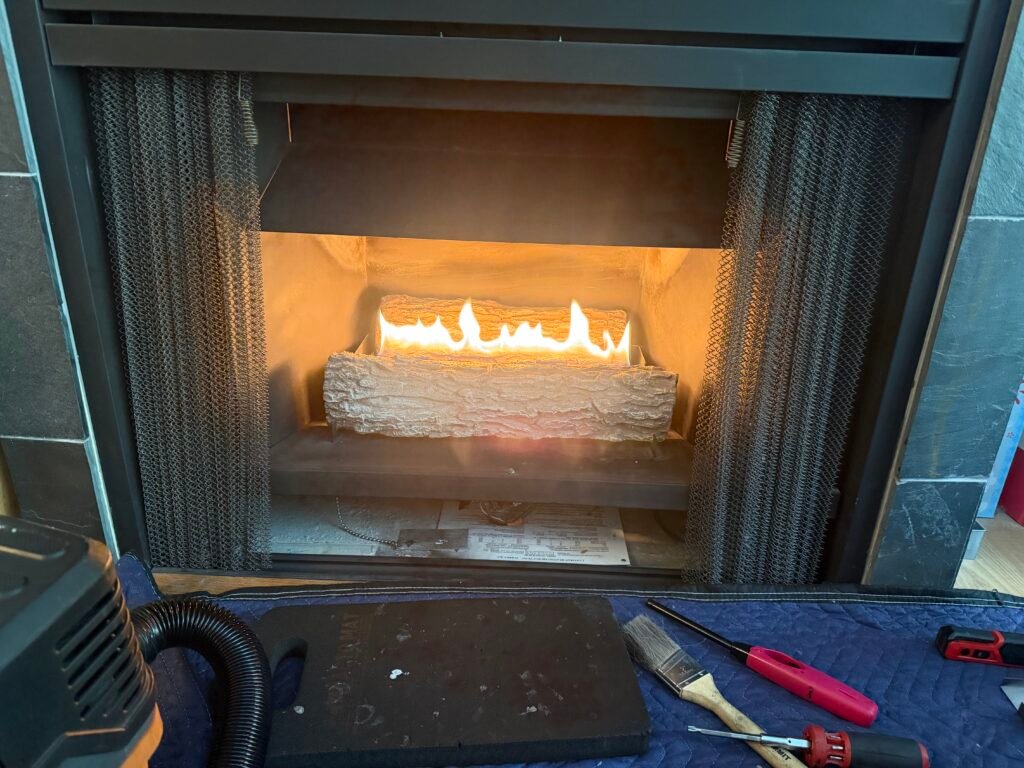
Why a Gas Fireplace Keeps Clicking
Electronic ignition systems use a spark, gas flow, and flame-sensing circuit in a precise sequence. If the control cannot confirm ignition, it may continue sparking or retry several times before entering lockout. During gas fireplace repair in Vancouver, these are the problems we most often investigate.
Weak Remote or Receiver Batteries
Low battery voltage can cause erratic receiver operation, incomplete valve movement, repeated start attempts, or a clicking relay. Replace batteries in both the handheld remote and the receiver with fresh, correctly installed batteries. A working remote display does not prove the receiver has enough power to operate the fireplace.
Dirty Pilot Assembly
Dust, lint, pet hair, oxidation, and renovation debris can disturb the pilot flame or interfere with the spark path. A weak or poorly shaped pilot may not ignite consistently or may fail to heat the flame sensor properly, causing the control to keep trying.
Misaligned Spark Electrode
The electrode needs the correct gap and position relative to the pilot hood or burner. If it has shifted, cracked, or become coated with residue, the spark may jump in the wrong place. You may hear clicking and even see a spark, but the gas does not ignite where intended.
Poor Electrical Ground
Many ignition modules depend on a clean grounding path to detect flame. Loose connectors, corrosion, damaged wiring, or a poor chassis ground can make the module behave as though no flame is present. It may keep sparking even after the pilot appears to light.
Blocked Pilot or Burner Port
A partially restricted pilot or burner port can delay ignition. Gas may not reach the spark quickly or evenly, so the system clicks repeatedly. Internal gas passages should not be cleaned with pins, drills, or improvised tools because changing the opening can affect safe combustion.
Flame Sensor Not Proving Flame
Electronic systems use flame rectification or another sensing method to confirm ignition. A dirty sensor, poor flame contact, damaged wire, weak pilot, or control issue may prevent proof of flame. The spark continues because the module does not recognize that ignition occurred.
Ignition Module Failure
A failing ignition module may spark continuously, retry at random, click while the unit is off, or stop only after power is removed. Module replacement should follow proper testing because similar symptoms can be caused by wiring, grounding, gas supply, or sensor problems.
Gas Valve or Supply Problem
If the spark is present but gas is not reaching the pilot, the issue may involve the appliance shutoff, gas pressure, valve coil, regulator, or control valve. Gas-pressure testing and valve diagnosis require a licensed technician and suitable instruments.
Incorrect Log or Media Placement
Logs, embers, glass media, or decorative stones placed outside the manufacturer’s layout can obstruct gas flow or delay flame travel. They may also cause soot or overheating. Never rearrange fireplace media by appearance alone; use the exact model instructions.
What You Can Check Before Calling a Technician
These checks stay outside the sealed combustion area and do not involve gas adjustments, wiring tests, or removal of safety components. If your fireplace is hot, allow it to cool fully before inspecting anything around the controls.
1. Replace all control batteries
Install fresh batteries in the remote and receiver. Clean only visible battery contacts if they show minor residue, and replace a damaged battery holder rather than forcing it to work.
2. Confirm the control mode
Make sure the receiver is set to REMOTE or ON as intended and that the handheld remote is not in timer, thermostat, child-lock, or low-temperature mode.
3. Check household power
For fireplaces using line power, verify the breaker, service switch, and outlet have not been turned off. Do not open an electrical box or test live terminals.
4. Observe through the glass
Watch whether a spark is visible, whether the pilot lights, and whether the main burner follows. Do not remove the glass to get a closer look.
5. Check the appliance shutoff position
If the shutoff valve is clearly visible and you know its normal operating position, confirm it has not been accidentally closed. Do not force a stiff valve.
6. Try one normal ignition cycle
After basic checks, request heat once and note the sequence. Avoid ten repeated attempts. The pattern from one careful test is more useful than a control system driven into lockout.
Clicking Plus Gas Odour Is an Emergency Warning
A clicking ignitor is designed to create a spark. If you also smell rotten eggs or hear hissing, do not keep trying the fireplace. Do not touch electrical switches, use a phone inside, smoke, light a match, or create another ignition source. Leave the building and call the FortisBC emergency line at 1-800-663-9911 or 911 from outside.
FortisBC also advises arranging professional service for delayed ignition, booming noises, frequent pilot outages, excessive soot, unusual odours, or possible carbon-monoxide symptoms. Review the official gas leak and odour instructions and gas appliance maintenance guidance.
How We Diagnose a Fireplace That Keeps Clicking
Replacing the loudest-looking component is not a diagnosis. A proper repair follows the ignition sequence, confirms gas and electrical conditions, and verifies safe operation after the fault is corrected.
Confirm the Exact Ignition Sequence
We reproduce the complaint and note when the clicking starts, whether spark is visible, whether the pilot lights, whether flame is proven, and whether the main burner opens.
Inspect the Firebox and Venting
The technician checks for soot, debris, damaged gaskets, incorrect media placement, blocked air openings, visible venting problems, and signs of delayed ignition.
Test Batteries, Wiring, and Grounding
Receiver output, connectors, ignition wiring, electrode condition, and grounding are inspected. This helps separate a power or signal fault from a gas-delivery problem.
Evaluate Pilot and Flame-Sensing Operation
The pilot flame, spark position, flame sensor, and ignition response are checked under operating conditions. Cleaning or adjustment is performed only within manufacturer specifications.
Check Gas Operation Where Required
A licensed gas technician may verify inlet pressure, manifold pressure, valve operation, and combustion behaviour using suitable instruments. These are not homeowner tests.
Complete Final Safety Testing
After repair, we confirm reliable ignition, stable flame, proper shutdown, acceptable flame appearance, intact seals, and safe operation. Carbon-monoxide and gas-leak checks are completed where appropriate.
Components That May Need Cleaning, Adjustment, or Replacement
Continuous clicking does not automatically mean the ignition module has failed. The correct repair depends on testing the complete circuit. Commonly involved components include:
Spark Electrode and Ignitor Cable
A cracked ceramic insulator, damaged cable, incorrect gap, loose connection, or contamination can weaken or redirect the spark.
Pilot Assembly
The pilot hood, injector, bracket, and flame pattern must work together. Some assemblies are serviceable; others require replacement as a complete manufacturer-approved unit.
Flame Sensor
A dirty or damaged sensor may fail to prove flame, causing continued sparking or shutdown. The sensor must be correctly positioned in the flame.
Ignition Control Module
The module controls spark timing, ignition attempts, and flame verification. It should be replaced only after power, grounding, wiring, and connected components have been tested. If clicking continues because the ignition sequence is repeatedly failing or locking out, see Gas Fireplace Control Module Problems for the module-specific diagnostic path.
Remote Receiver or Control Board
Battery leakage, heat, age, or electrical damage can create clicking relays, random starts, intermittent response, or incomplete ignition commands.
Gas Control Valve
A valve may fail electrically or mechanically, but valve replacement requires correct diagnosis, leak testing, and pressure verification by a qualified gas technician.
Is a Clicking Fireplace Usually Worth Repairing?
Repair Usually Makes Sense When
The fireplace is in otherwise good condition, the venting and glass are sound, the required part is available, and the problem is limited to batteries, wiring, a pilot assembly, electrode, receiver, sensor, or control component.
Replacement May Be Smarter When
The unit has a damaged firebox, unsafe or obsolete venting, unavailable controls, repeated major failures, severe corrosion, cracked glass, or repair costs that approach the value of a modern replacement. We explain the evidence before recommending replacement.
Gas Fireplace Brands We Diagnose and Repair
SkyLimit Heating works on many fireplace systems found across Vancouver, Burnaby, Coquitlam, Port Coquitlam, Richmond, North Vancouver, and surrounding Lower Mainland communities.
Brand-specific help: Owners of Montigo units can also review our Montigo fireplace repair service. Always use the model manual for ignition and reset instructions because control systems vary considerably between brands and production years.
Continue Troubleshooting the Exact Symptom
These internal resources help separate a clicking problem from other common fireplace failures and connect this guide to the main Vancouver service page.
Main service page: Fireplace Repair Vancouver. Book professional diagnosis for clicking, delayed ignition, pilot failure, shutdowns, weak flame, and other fireplace problems. View repair service →
Local service Fireplace Repair North Vancouver Professional gas fireplace troubleshooting and repair for North Vancouver homes, condos, and strata properties. View local service →
Independent safety sources: Technical safety requirements for gas appliances in British Columbia are established under provincial legislation and enforced by Technical Safety BC and delegated municipalities. See the Province of British Columbia’s Safety Standards Act overview.
Gas Fireplace Clicking FAQ
Is clicking normal when a gas fireplace starts?
A few clicks during electronic ignition can be normal. Continuous clicking, repeated failed attempts, clicking after the flame is established, or clicking with gas odour is not normal and should be investigated.
Why does my fireplace click but not light?
Common causes include weak receiver batteries, no gas reaching the pilot, a dirty pilot assembly, a misaligned spark electrode, damaged ignition wiring, poor grounding, or a failed ignition module.
Why does the clicking continue after the pilot lights?
The control may not be proving flame because of a weak pilot, dirty or poorly positioned flame sensor, grounding problem, damaged sensor wire, or control-module fault.
Can I keep trying to start it?
Do not repeatedly cycle a fireplace that is failing to ignite. Repeated attempts can trigger lockout and may create a delayed-ignition hazard. Stop immediately if you smell gas, hear hissing, see soot, or experience booming ignition.
Will changing the batteries stop the clicking?
It may, especially when the receiver is battery powered or the clicking comes from a relay. Replace batteries in both the remote and receiver. If the problem remains, further diagnosis is required.
Does continuous clicking mean the ignition module is bad?
Not necessarily. A module can fail, but the same symptom can result from poor grounding, a dirty pilot, a damaged electrode, weak flame sensing, wiring faults, or no gas flow. Testing should come before replacement.
How long does fireplace clicking repair take?
Many common ignition repairs can be completed during one appointment when the correct part is available. Intermittent faults, concealed wiring problems, older controls, or discontinued parts may require additional time.
Should a gas fireplace be serviced every year?
Annual inspection and maintenance are sensible for a fuel-burning appliance. FortisBC recommends regular service by a licensed gas contractor, and fireplace service commonly includes inspection of the burner, gas valve, ignition system, door gaskets, venting, and air openings.
Stop the Clicking and Restore Reliable Ignition
SkyLimit Heating and Gas provides professional gas fireplace troubleshooting across Vancouver and the Lower Mainland. We diagnose the full ignition sequence, explain the failed component, and verify safe operation after the repair.