
FIREPLACE COMPONENT GUIDE
Gas Fireplace Pilot Assembly Problems: Symptoms, Causes & Repair
The pilot assembly is one of the first places to investigate when a gas fireplace will not stay lit, keeps clicking, ignites slowly, or develops an unstable pilot flame.
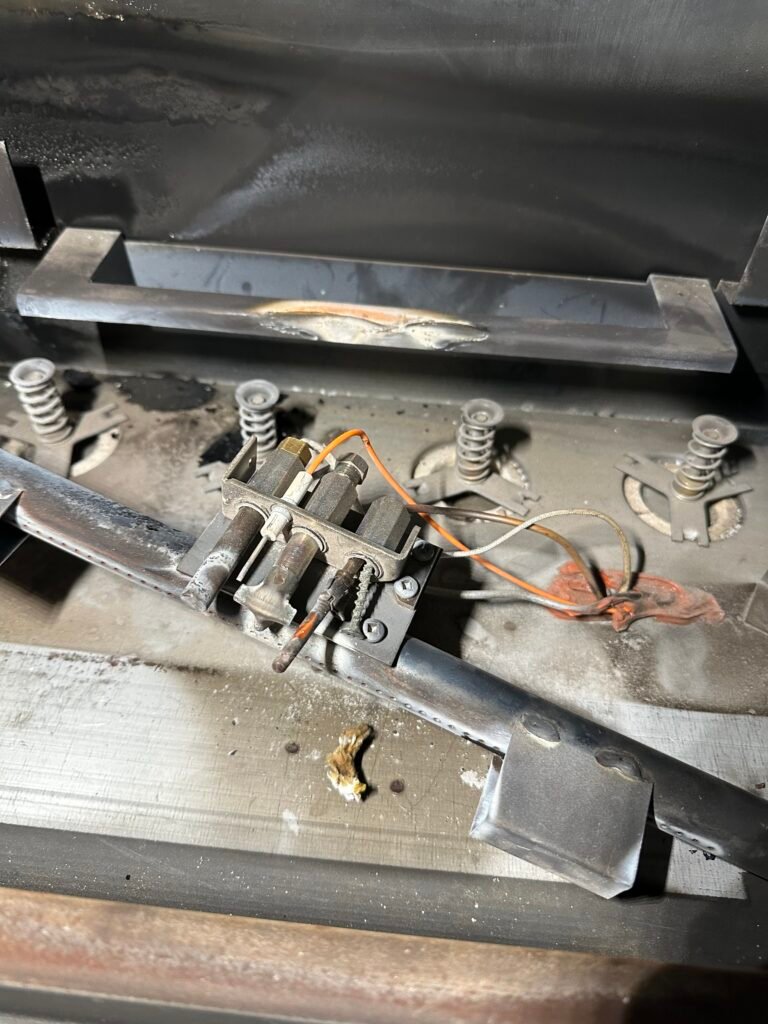
But the pilot assembly is not just one part. Depending on the fireplace, it may include the pilot hood, pilot orifice, igniter electrode, thermocouple, thermopile, flame sensor, tubing, and mounting bracket.
✓ Licensed & Insured ✓ Metro Vancouver ✓ Fireplace Diagnostics
QUICK ANSWER
What Does a Gas Fireplace Pilot Assembly Do?
The pilot assembly creates and controls the small flame used to ignite the main burner and, on many fireplaces, heat the flame-safety sensors.
If the pilot flame is weak, dirty, misdirected, or unstable, the fireplace may fail to prove flame, fail to open the main gas valve, shut down after ignition, or repeatedly try to relight.
DIAGNOSTIC SNAPSHOT
Common Symptoms of Pilot Assembly Problems
Pilot Will Not Stay Lit
Weak flame, dirty pilot, thermocouple, or gas-control issue may be involved.
Repeated Clicking
The igniter may be sparking without successfully establishing or proving flame.
Weak or Tiny Pilot Flame
Pilot orifice contamination, supply issues, or incorrect pilot setup may be reducing flame size.
Pilot Flame Looks Yellow
Contamination, air or fuel conditions, or pilot damage may be affecting combustion.
Burner Lights Slowly
Pilot position, burner ignition path, contamination, or delayed ignition may be involved.
Fireplace Shuts Off After Starting
Pilot stability or flame-sensing can fail after the unit warms.
WHAT’S INSIDE
What Is Included in a Gas Fireplace Pilot Assembly?
The exact design varies by fireplace model, but a pilot assembly may contain several tightly packed components that work together.
- Pilot hood: directs the pilot flame toward the correct ignition and sensing locations.
- Pilot orifice: meters the small amount of gas used by the pilot.
- Igniter electrode: creates the spark used to light the pilot or burner.
- Thermocouple: used on many standing-pilot systems as part of the flame-safety circuit.
- Thermopile: used on many millivolt fireplaces to help power the main burner circuit.
- Flame sensor: used on many electronic ignition systems to prove flame electronically.
- Pilot tubing and fittings: deliver gas to the pilot assembly.
This is why “replace the pilot” can mean very different things depending on the fireplace model. Some manufacturers supply individual components; others supply the pilot assembly as one approved service part.
COMMON FAILURE PATHS
9 Common Gas Fireplace Pilot Assembly Problems
1. Dirty Pilot Orifice
Dust, lint, pet hair, renovation debris, and fine contamination can reduce gas flow through the tiny pilot orifice. The result may be a weak or distorted flame.
2. Pilot Hood Contamination
Residue around the pilot hood can change the direction of the flame so it no longer properly contacts the thermocouple, thermopile, flame sensor, or burner ignition area.
3. Misaligned Pilot Assembly
If the pilot bracket or assembly has shifted, the flame may be present but aimed incorrectly. This can create ignition delays or poor flame sensing.
4. Cracked or Damaged Electrode
A ceramic igniter insulator can crack, allowing spark energy to short to nearby metal instead of reaching the intended ignition point.
5. Weak Thermocouple
On standing-pilot systems, the pilot may light but go out when the control knob is released. See our dedicated Gas Fireplace Thermocouple Problems guide.
6. Weak Thermopile
The pilot may remain lit while the main burner becomes unreliable. For that symptom, see Gas Fireplace Thermopile Problems.
7. Loose or Damaged Pilot Tubing
Pilot tubing, fittings, and connections are gas components and should be inspected for damage or leakage by a qualified technician.
8. Incorrect Replacement Assembly
Pilot assemblies can look nearly identical while using different orifice sizes, sensors, brackets, fuel types, or ignition systems. The correct manufacturer-approved part matters.
9. Venting or Draft Conditions
A pilot assembly can test normally while an external operating condition repeatedly disturbs the flame. Venting, air supply, and fireplace sealing may need to be checked.
NORMAL OPERATION OR A FAULT?
Should the Pilot Stay On When the Fireplace Is Off?
Not on every fireplace. An unlit pilot while the appliance is idle does not, by itself, mean the pilot assembly needs repair. Some systems light the pilot when heat is requested; others can keep it burning between uses. Certain controls also extinguish it after a period of inactivity. The installed model, selected mode and owner’s manual determine the expected behaviour.
| When you noticed it | What to establish first |
|---|---|
| Immediately after selecting OFF | Does the manual say OFF extinguishes both burner and pilot, or does the selected mode retain the pilot? |
| After several days without use | Does this control have an automatic pilot shutdown? Check the specific interval rather than assuming every brand uses the same timer. |
| During a requested heating cycle | Unexpected flame loss, repeated ignition attempts or an error message need a different assessment from a pilot that switches off while idle. |
A manufacturer example—not a universal timer
Valor explains that its SmartPilot system can automatically shut off the pilot after seven days of inactivity. Its remote-control comparison also lists different pilot-shutdown intervals for different controls. These are examples of intended operation, not a rule for every Valor model or other fireplace brand. See Valor’s getting-started guide and remote-control features, then use the manual matching your fireplace.
What if it used to stay on, but now switches off?
Note whether someone changed a pilot mode, used a different OFF command, replaced a control, or left the fireplace unused longer than usual. Report those changes without opening the appliance or altering its settings to force continuous operation. A change in behaviour warrants clarification; it does not prove a worn thermocouple.
If the pilot goes out while it should remain lit, use our pilot light won’t stay lit guide. If it lights normally but the burner never starts, see pilot on with no main-burner flame. For abnormal operation, book fireplace diagnosis rather than repeatedly resetting the control.
FLAME PATTERN
What Should a Healthy Gas Fireplace Pilot Flame Look Like?
A healthy pilot flame should be stable and positioned according to the manufacturer’s design. Its exact shape varies by fireplace, so there is no single universal flame pattern that applies to every model.
Signs the Pilot Needs Attention
- Pilot flame is unusually small.
- Flame repeatedly lifts or flickers away from the sensors.
- Pilot is heavily yellow rather than following the expected model-specific appearance.
- Flame does not properly contact the thermocouple or thermopile where applicable.
- Pilot makes an unusual noise.
- Pilot repeatedly goes out.
If the pilot repeatedly goes out, continue to Gas Fireplace Pilot Light Won’t Stay Lit.
Pilot Sparks but Will Not Ignite
When the igniter is visibly sparking, but no pilot flame appears, the problem is not necessarily the igniter. A spark only confirms that some ignition energy is reaching the pilot area.
Possible causes include:
- Pilot gas is not reaching the assembly.
- Pilot orifice is restricted.
- Spark is occurring in the wrong location.
- Electrode is cracked or misaligned.
- Gas valve or control is not supplying pilot gas.
- Air may be present in the gas line after service or extended shutdown, depending on the appliance condition and manufacturer procedure.
For repeated spark cycles, see Gas Fireplace Keeps Clicking.
SAFETY WARNING
A Pilot Problem Can Lead to Delayed Ignition
If the pilot does not light the burner promptly, gas can reach part of the burner before ignition occurs. A loud pop or boom at startup is not something to normalize.
FortisBC identifies frequent pilot outages, delayed ignition or booming, yellow or wavering flame, excessive soot, and appliance or vent damage as warning signs that should be professionally inspected.
HOMEOWNER CHECKS
Safe Checks Before Booking Pilot Assembly Repair
- Identify your ignition type: some fireplaces use a standing pilot while newer models may use intermittent electronic ignition.
- Follow the manufacturer’s lighting instructions: do not improvise the ignition sequence.
- Observe the pilot flame: note size, stability, direction, and whether it reaches the sensors.
- Listen to the ignition sequence: repeated clicking, delayed flame, or booming should be reported.
- Check the fireplace model: the rating plate helps identify the correct pilot assembly and service information.
- Stop if you smell gas: leave the building immediately and call FortisBC at 1-800-663-9911 or 911 from outside. Do not use switches, phones or flames inside.
Do Not Drill or Clean the Pilot Orifice With a Hard Tool
The pilot orifice is precisely sized. Enlarging or damaging it can change gas flow and combustion. Do not modify pilot components or substitute an unapproved assembly.
PROFESSIONAL DIAGNOSIS
How We Diagnose Pilot Assembly Problems
- Identify the fireplace model and ignition system. Pilot assemblies differ significantly between models.
- Observe startup from cold. We look at spark location, pilot ignition, flame shape, and main burner ignition timing.
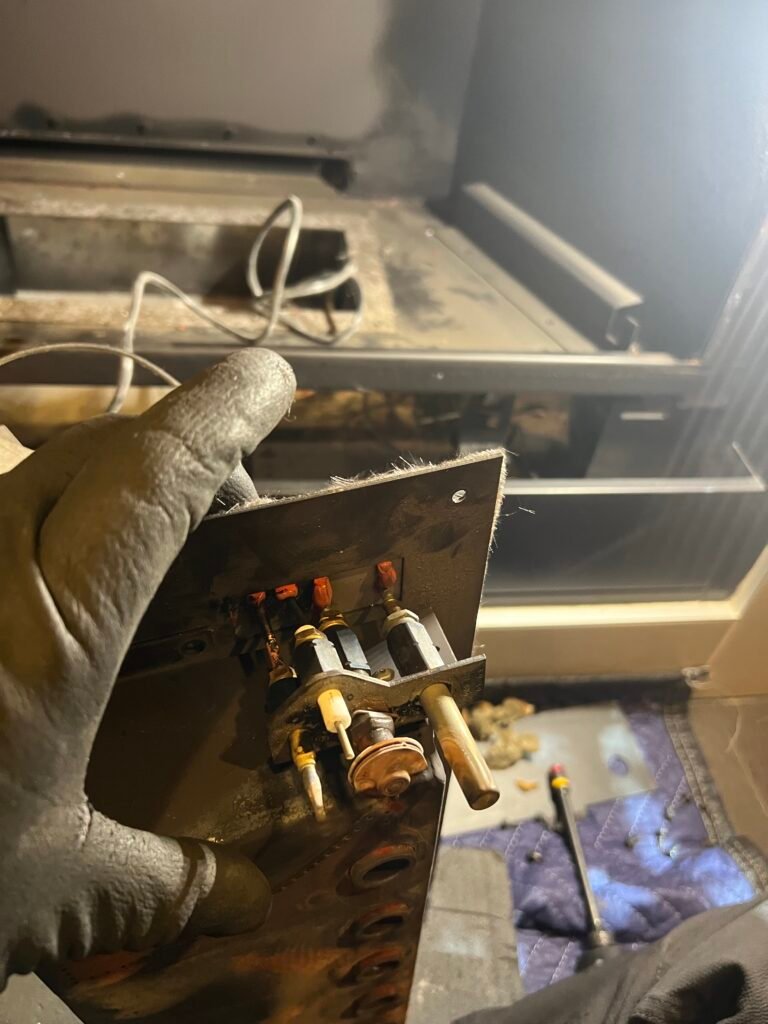
- Inspect the pilot assembly. Pilot hood, orifice condition, electrode, sensors, bracket, tubing, and wiring are checked.
- Test flame-safety components. Thermocouple, thermopile, or flame-sensing operation is evaluated according to the fireplace design.
- Check the gas control and circuit. A pilot assembly can be healthy while the control supplying it is not.
- Check burner ignition and related venting conditions. Delayed ignition is not treated as an isolated pilot issue.
- Run a complete operational test. The fireplace is tested through ignition, warm-up, shutdown, and restart where appropriate.
REPAIR OPTIONS
Common Pilot Assembly Repairs
Pilot Cleaning
Remove appropriate contamination without altering the pilot orifice.
Electrode Replacement
Replace a cracked or damaged igniter when the approved part is available separately.
Thermocouple / Thermopile Repair
Test the actual sensor before replacing it.
Complete Pilot Assembly Replacement
Install the correct approved assembly when individual components are damaged or not separately serviceable.
Connection Repair
Repair damaged wiring, fittings, or mounting issues as appropriate.
Gas-Control Diagnosis
Confirm the valve or control is supplying the pilot correctly before replacing the assembly.
BRITISH COLUMBIA GAS SAFETY
Pilot Assembly Work and Gas Safety in BC
Technical Safety BC states that regulated gas work in British Columbia must be performed by a licensed or otherwise authorized person, and licensed contractors are responsible for complying with applicable safety requirements. It also provides a public registry for checking contractor licence status.
CONTINUE TROUBLESHOOTING
Related Gas Fireplace Guides
WHY SKYLIMIT HEATING
Pilot Diagnosis Before Parts Replacement
A pilot assembly can contain several serviceable components, and a symptom that looks like a bad pilot can also come from the gas valve, venting, thermocouple, thermopile, receiver, or ignition control. We diagnose the operating sequence before recommending replacement.
- Licensed and insured gas service
- Pilot assembly and flame-safety troubleshooting
- Thermocouple, thermopile, igniter, gas-valve and control diagnosis
- Manufacturer-specific part identification
- Service for major gas fireplace brands
- Metro Vancouver and Fraser Valley coverage
COMMON QUESTIONS
Gas Fireplace Pilot Assembly FAQ
What is included in a gas fireplace pilot assembly?
Depending on the fireplace, the assembly may include a pilot hood, pilot orifice, igniter electrode, thermocouple, thermopile or flame sensor, tubing, wiring, and mounting bracket.
Can a dirty pilot assembly stop a fireplace from working?
Yes. Contamination can reduce pilot gas flow, distort the flame, prevent proper sensor heating, or interfere with ignition.
Why does my pilot spark but not light?
Possible causes include restricted pilot gas flow, an incorrectly located spark, a cracked electrode, a gas-control problem, or another issue preventing pilot gas from reaching the ignition point.
Can the pilot assembly cause delayed ignition?
Yes. Pilot position, flame size, contamination, electrode condition, or burner ignition conditions can contribute to delayed ignition. A loud pop or boom should be professionally inspected.
Should I replace the entire pilot assembly?
Not automatically. Some problems can involve an individual component, while some manufacturers supply the pilot assembly as one approved service part. Diagnosis and model-specific parts information should guide the repair.
Can I clean a gas fireplace pilot orifice myself?
The pilot orifice is precisely sized and should not be drilled, enlarged, or damaged with hard tools. Pilot service should follow the manufacturer’s instructions.
Does every fireplace use the same pilot assembly?
No. Pilot assemblies vary by manufacturer, model, fuel type, ignition system, sensor configuration, and mounting design.
Do you repair gas fireplace pilot assemblies in Vancouver?
SkyLimit Heating diagnoses and repairs pilot, ignition, thermocouple, thermopile, gas-valve, and related fireplace problems across Metro Vancouver and the Fraser Valley.
NEED PROFESSIONAL HELP?
Pilot Flame Weak, Clicking, or Won’t Stay Lit?
SkyLimit Heating can inspect the pilot assembly, igniter, thermocouple, thermopile, gas control, and burner ignition sequence to find the actual cause.